
NEMA G10 · IEC EPGC 201 · IS 13529 — Component Manufacturer in Maharashtra, India
G10 Epoxy Laminate
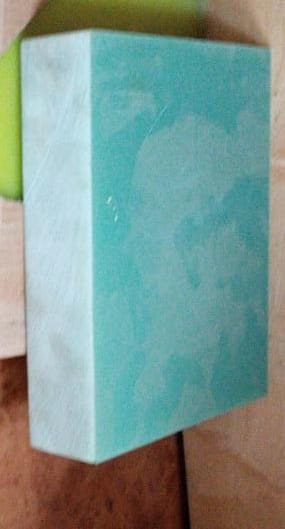
G10 epoxy laminate — also designated EPGC 201 under IEC 60893, NEMA G10 under NEMA LI-1, and HGW 2372 under German DIN standards — is the most widely used general-purpose glass cloth reinforced epoxy insulation material in the world. It is produced by impregnating layers of woven E-glass fibre fabric with a halogen-free thermosetting epoxy resin and curing the assembly under heat and pressure into a dense, void-free composite laminate.
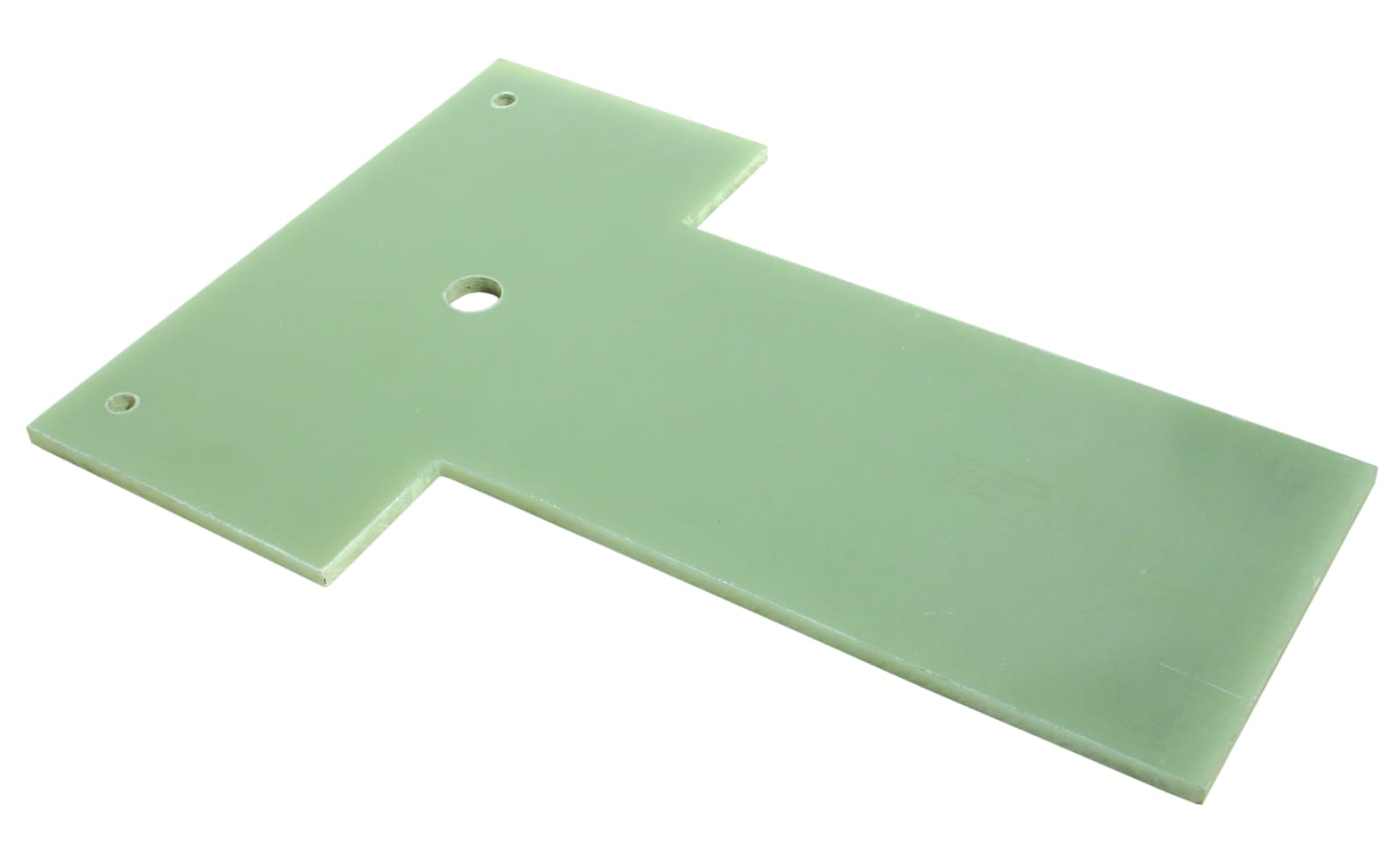
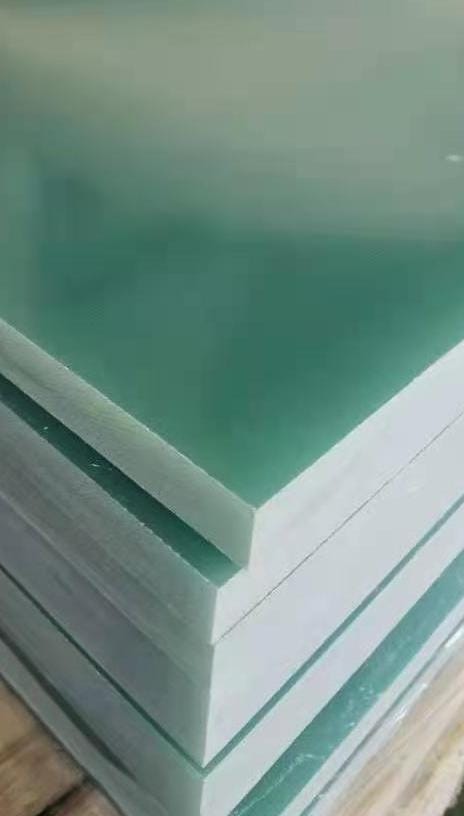
The result is a rigid, electrically insulative structural material combining dielectric strength up to 22 kV/mm, tensile strength above 300 MPa, and a glass transition temperature of 130°C — with outstanding machinability that allows CNC routing, milling, drilling, and turning to tight tolerances. ACC Insulations manufactures G10 epoxy laminate Component as flat sheets from 0.5 mm to 100 mm thickness and as precision CNC-machined components to OEM engineering drawings.

Technical Specifications
| G10 Epoxy Laminate (EPGC 201) — Complete Technical Data | |
|---|---|
| IEC 60893 Grade | EPGC 201 |
| NEMA LI-1 Grade | G10 |
| Indian Standard | IS 13529 |
| MIL-Spec Equivalent | MIL-I-24768/2 |
| DIN Equivalent | HGW 2372 |
| Reinforcement | Woven E-Glass Cloth Fabric (alkali-free) |
| Resin System | Halogen-Free Thermosetting Epoxy Resin |
| Thickness Range | 0.5 mm to 100 mm (flat sheets; custom CNC components from drawings) |
| Standard Sheet Sizes | 1020 × 1220 mm | 1220 × 2440 mm | Custom on request |
| Dielectric Strength (⊥, in oil) | Up to 22 kV/mm (IEC 60243, perpendicular to layers) |
| Dielectric Strength (∥, in air) | >60 kV (parallel to layers, standard thickness) |
| Tensile Strength | >300 MPa (warp & fill directions) |
| Flexural Strength | 400–550 MPa |
| Compressive Strength | >250 MPa (perpendicular to layers) |
| Volume Resistivity | >1012 Ω·cm |
| Dielectric Constant (Dk @ 1 MHz) | 4.2 – 4.8 |
| Dissipation Factor (Df @ 1 MHz) | 0.020 – 0.035 |
| Glass Transition Temp (Tg) | ~130°C |
| Thermal Class | Class B / Class F — 130°C continuous service |
| Water Absorption | <0.1% (24h immersion per IEC 60893) |
| Density | 1.80 – 1.90 g/cm³ |
| Flame Rating | Not inherently flame retardant — for UL 94 V-0 specify FR4 |
| Halogen Content | Halogen-free epoxy resin (no bromine) |
| Machinability | Excellent — CNC routing, milling, drilling, turning |
| CNC Tolerance | ±0.05 mm (standard); tighter on request |
| Colours Available | Natural green/yellow, black, custom colour on request |
| Standards | IEC 60893, NEMA LI-1, IS 13529, MIL-I-24768/2 |
What Is G10 Epoxy Laminate?
G10 epoxy laminate is a composite structural insulation material produced by stacking multiple plies of woven E-glass fibre fabric, impregnating them with halogen-free thermosetting epoxy resin, and curing the assembly under controlled heat and pressure in a hydraulic press. The process creates a dense, void-free laminate where the continuous woven glass fibres carry mechanical loads and the cured epoxy matrix provides chemical resistance, moisture protection, and cohesion between layers.
The "G" in G10 stands for glass — confirming woven glass cloth reinforcement. The "10" is the NEMA LI-1 property class number that specifies the combination of electrical, mechanical, and thermal properties this grade must meet. Under IEC 60893, the same material is codified as EPGC 201: EP = epoxy resin, GC = glass cloth, 201 = the property series number.
Key Electrical & Mechanical Properties
G10 vs G11 vs FR4 vs FR5 — Grade Comparison
Selecting the correct epoxy laminate grade is the single most important specification decision. Here is how G10 compares to the other three grades in the family, so you can confirm whether G10 is the right grade for your application:
| Grade | IEC Designation | Max Temp (Tg) | Flame Rating | Halogen-Free | Best For |
|---|---|---|---|---|---|
| G10 ← You are here | EPGC 201 | 130°C | Not rated | ✓ Yes | General insulation, halogen-free spec, terminal boards |
| G11 | EPGC 202 | 155°C+ | Not rated | No (standard) | High-temp: transformer spacers, motor wedges, Class H |
| FR4 | EPGC 203 | 130°C | ✓ UL94 V-0 | No (bromine) | Fire-rated: PCB, switchgear, UL-compliant panels |
| FR5 | — | 155°C+ | ✓ UL94 V-0 | No (bromine) | High-temp + flame retardant: HV switchgear, EHV transformers |
Epoxy Laminate Grade Family
General Purpose · Halogen-Free
Standard glass cloth epoxy for terminal boards, switchgear barriers, structural components. Halogen-free. Tg 130°C. Not flame-rated. The default specification for applications where UL 94 V-0 is not required.
High-Temperature Grade
Retains full mechanical strength above 130°C up to 155–180°C. Mandatory for transformer spacers, motor slot wedges, and Class F/H rated equipment. Tg ~175°C.
View G11 page →Flame Retardant Grade
UL 94 V-0 self-extinguishing. Equivalent mechanical and dielectric properties to G10 but with bromine-based flame retardancy. The mandatory grade for PCBs, switchgear panels, and UL-listed equipment.
View FR4 page →High-Temp + Flame Retardant
Combines G11's elevated-temperature mechanical retention with FR4's UL 94 V-0 rating. Specified for demanding HV switchgear and high-MVA transformer applications requiring both properties.
Thickness Range: 0.5 mm to 100 mm
G10 epoxy laminate is available across the full thickness range required by electrical insulation applications — from very thin inter-phase separators to heavy structural blocks:
Ultra-Thin Sheets
Inter-layer barriers, slot cell liners, PCB-equivalent insulation applications, phase separators in tight assemblies
Thin Sheets
Terminal boards, mounting plates, phase barriers in control panels, switchgear inter-phase insulation
Medium Sheets
Transformer insulation components, structural supports, busbar saddles, arc chute assemblies
Heavy Sections
CNC-machined structural insulation parts, tooling plates, jigs, fixtures, precision cryogenic supports
CNC-Machined G10 Components We Manufacture
G10 is one of the finest-machining electrical insulation materials available. ACC Insulations operates CNC machining centres in Nashik to produce custom G10 components to customer engineering drawings with tolerances to ±0.05 mm:
Flat or formed G10 barriers isolating R, Y, B phases in switchgear, MCC panels, and motor terminal boxes. Custom profile to drawing.
Multi-terminal connection insulation boards for transformer terminal boxes and motor junction boxes. Drilled and slotted to specification.
G10 saddle and cleat insulators holding busbar conductor in LV and MV switchgear assemblies with required phase-to-phase clearances.
High arc-resistance G10 splitter plates and arc chute assemblies for contactors, circuit breakers, and switchgear arc interruption.
Precision-machined G10 spacers maintaining conductor clearances in transformer winding assemblies. Suitable up to 130°C operating temp.
G10 is a preferred material for structural insulation at cryogenic temperatures — superconductor, LNG, and MRI magnet applications.
G10 wedges for motor stator slot closing at ambient to moderate temperatures. For Class F/H applications upgrade to G11.
Jigs, fixtures, and precision tooling plates machined from heavy G10 sections. Dimensionally stable alternative to metal for non-conductive tooling.
Complex 2D and 3D profiles, stepped sections, slots, and contoured shapes machined from G10 sheet to customer DXF/DWG files.
Applications of G10 Epoxy Laminate
G10 epoxy laminate is used wherever a combination of reliable electrical insulation, mechanical rigidity, low moisture absorption, and excellent machinability is required — at operating temperatures up to 130°C continuous:
Why G10 Outperforms Conventional Insulation Materials
G10 epoxy laminate replaced phenolic paper laminates (FR2/XPC), Bakelite, and pressboard-based structural insulation in most non-oil applications decades ago — and for measurable engineering reasons:
3–5× Greater Mechanical Strength
Woven glass cloth reinforcement delivers tensile and flexural strength far exceeding phenolic paper laminates (FR2, XPC) at equivalent thickness — enabling thinner, lighter components without strength compromise.
Far Lower Moisture Absorption
At <0.1% water absorption (24h), G10 absorbs a fraction of what phenolic paper laminates do — maintaining stable dielectric strength across all humidity conditions including coastal and tropical industrial environments.
Excellent CNC Machinability
G10 routes, mills, drills, and turns cleanly with carbide tooling — producing tight-tolerance components, clean drilled holes, and smooth profiles that phenolic laminates cannot match without delaminating or chipping.
Chemical Resistance
The cross-linked epoxy matrix resists solvents, mild acids, and alkalis that attack cellulose-based materials — stable in transformer oils, cleaning agents, and industrial chemical environments.
Halogen-Free Construction
G10 uses halogen-free epoxy resin — no bromine additives. This matters in applications where halogen-free specifications are mandated: rail rolling stock, certain export markets, and green procurement specifications.
Dimensional Stability
Glass epoxy laminates do not swell, shrink, or warp significantly with temperature or humidity changes — maintaining consistent fit, electrical clearances, and mechanical loads over the full service life.
How G10 Epoxy Laminate Components are Manufactured
G10 epoxy laminate are produces through a controlled hot-press lamination process. Every step is process-controlled to ensure consistent dielectric performance, mechanical uniformity, and dimensional accuracy:
- Glass fabric selection: Woven E-glass (alkali-free) fabric is selected to specified areal weight, weave pattern, and fibre sizing for compatibility with the halogen-free epoxy resin system.
- Resin impregnation: E-glass fabric plies are impregnated with halogen-free thermosetting epoxy resin formulated for EPGC 201 grade. Resin content and impregnation uniformity are process-controlled to achieve target density and electrical properties.
- Layup and stacking: Resin-impregnated fabric plies are stacked to the target thickness. Ply count and resin content are calculated to achieve density 1.80–1.90 g/cm³ and the required mechanical property profile.
- Hot-press curing: The stacked assembly is placed in a hydraulic hot press where heat (120–180°C) and pressure consolidate plies, drive out volatiles, and fully cure the epoxy resin — producing a dense, void-free laminate with no internal delamination.
- Sheet cutting and surface finishing: Cured laminate panels are cut to standard or customer-specified dimensions, surface-finished, and inspected for thickness uniformity, surface quality, and edge condition.
- CNC machining (optional): For machined component orders, flat G10 sheets are then processed through our CNC machining centres per customer DXF/DWG drawings to ±0.05 mm tolerance.
- Quality verification: Each batch is tested for thickness, density, dielectric strength, and water absorption per IEC 60893 before release. Batch test certificates available with every shipment.
Standards & Compliance
- IEC 60893 — EPGC 201: International standard for thermosetting industrial laminates for electrical purposes. G10 corresponds to the EPGC 201 grade designation.
- NEMA LI-1 — G10: US standard for industrial laminated thermosetting products. G10 is the NEMA grade designation for this glass cloth epoxy laminate.
- IS 13529 (India): Indian Standard for glass fabric reinforced epoxy laminates. G10 / EPGC 201 is referenced for procurement by Indian transformer and switchgear OEMs.
- MIL-I-24768/2: US military specification equivalent for G10. Required for defence and aerospace insulation components.
- IEC 60085 — Thermal Class B/F: G10 is rated for Thermal Class B (130°C) continuous service per IEC 60085.
Industries Served
- Switchgear & control panel manufacturing — phase barriers, busbar supports, arc chutes, inter-phase separators
- Distribution transformer manufacturing — spacers, terminal boards, lead supports at ambient to 130°C
- Electric motor manufacturing — phase separators, slot wedges, motor end-winding components (Class B/F duty)
- PCB & electronics manufacturing — G10 substrate (especially for halogen-free specifications)
- Renewable energy (solar & wind) — inverter and generator insulation at operating temperatures up to 130°C
- Railway & traction — structural insulation components where halogen-free construction is required
- Cryogenic engineering — structural and electrical insulation at cryogenic temperatures where G10 maintains properties better than most alternatives
- Defence & aerospace (MIL-I-24768/2) — structural composite insulation components to military specification
Engineering Tools Suite
Calculate precise dielectric clearances, determine whether G10 or G11 is correct for your thermal class, and select the right epoxy laminate grade for your specific application voltage, temperature, and mechanical load requirements.
Frequently Asked Questions
G10 epoxy laminate (NEMA grade G10 / IEC EPGC 201) is a woven E-glass cloth reinforced thermosetting epoxy resin composite. It is the most widely used general-purpose electrical insulation laminate globally, valued for its combination of high dielectric strength (up to 22 kV/mm), tensile strength above 300 MPa, glass transition temperature of 130°C, low moisture absorption (<0.1%), and outstanding machinability. Common applications include terminal boards, phase barriers, arc chutes, busbar supports, transformer spacers (up to 130°C), motor phase separators, PCB substrate material, cryogenic structural insulation, and precision-machined components for switchgear and control panels.
G10 and FR4 share an almost identical base composition — both are woven E-glass cloth reinforced thermosetting epoxy laminates with very similar mechanical and dielectric properties. The single critical difference is flame retardancy. G10 does not carry a UL 94 flame retardancy rating and uses halogen-free epoxy resin. FR4 incorporates bromine-based flame retardant chemistry and meets UL 94 V-0 (self-extinguishing within 10 seconds). FR4 is the mandatory specification wherever UL 94 V-0 compliance is required — switchgear panels, PCB fabrication, electrical enclosures. G10 is specified where halogen-free materials are mandated, where flame retardancy is explicitly not a regulatory requirement, or where maximum electrical performance and machinability are the priority without brominated additives.
Under IEC 60893, G10 is designated EPGC 201 — where EP = epoxy resin, GC = glass cloth reinforcement, and 201 is the property class number. Under Indian Standard IS 13529, the same material is referenced as EPGC 201. Under German DIN/VDE standards it is HGW 2372. Under US military specification MIL-I-24768, the equivalent is MIL-I-24768/2. All four designations refer to the same general-purpose glass cloth epoxy laminate composition with the same property requirements. If your engineering drawing specifies EPGC 201, NEMA G10, or HGW 2372, ACC Insulations supplies the correct material.
G10 has a glass transition temperature (Tg) of approximately 130°C and is rated for continuous service at up to 130°C (IEC Thermal Class B/F). Below 130°C, G10 maintains its full mechanical and dielectric performance. Above the Tg, the epoxy resin begins to soften and mechanical strength — particularly flexural and compressive strength — drops significantly. This is not a sudden failure but a gradual property degradation that can cause dimensional change and loss of structural integrity under load. For applications requiring sustained operating temperatures above 130°C — such as transformer spacers in Class F insulation systems at 155°C or motor slot wedges in Class H motors — G11 epoxy laminate must be specified instead.
ACC Insulations supplies G10 epoxy laminate from 0.5 mm to 100 mm thickness as flat sheets in standard sizes of 1020 × 1220 mm and 1220 × 2440 mm, with custom sizes available on request. We also produce precision CNC-machined G10 components — phase barriers, terminal boards, busbar saddles, arc chute plates, spacers, and any custom-profiled parts — from flat sheet stock to customer drawings with tolerances to ±0.05 mm. Both flat sheet supply and machined component orders are handled without minimum order restrictions.
Yes — G10 is one of the best-machining electrical insulation materials available. It can be CNC routed, milled, drilled, and turned with carbide-tipped tooling to produce clean edges, burr-free holes, and complex profiles without delamination. ACC Insulations operates CNC machining centres in Nashik producing custom G10 components to ±0.05 mm tolerance from customer DXF or DWG drawings. We produce phase barriers, terminal boards, slot wedges, busbar saddles, arc chute plates, transformer spacers, cryogenic support components, tooling plates, and any custom profiled insulation part. Please provide your engineering drawing or DXF file for a quotation.
G10 epoxy laminate achieves a dielectric strength of up to 22 kV/mm measured perpendicular to the laminate layers (tested in oil per IEC 60243). Parallel to the laminate layers (along the surface), the breakdown voltage typically exceeds 60 kV for standard thickness sheets. Volume resistivity exceeds 10¹² Ω·cm. These properties make G10 suitable for medium-voltage electrical insulation in switchgear, transformer components, and motor insulation at system voltages up to approximately 33 kV. For exact dielectric strength values at your specific thickness and test conditions, we can provide material test certificates on request.
Use G10 when: (1) your continuous operating temperature is below 130°C — G10 is ideal and more cost-effective than G11 in this range; (2) you need halogen-free materials — G10 uses halogen-free epoxy while FR4 contains bromine; (3) UL 94 V-0 flame retardancy is not a compliance requirement — if flame retardancy is needed, specify FR4 instead; and (4) cryogenic applications — G10 is the preferred glass epoxy grade for structural insulation at cryogenic temperatures. Upgrade to FR4 when UL 94 V-0 is required. Upgrade to G11 when operating temperature exceeds 130°C continuous or the application demands retained mechanical strength above 130°C (transformer spacers, motor slot wedges, Class F/H rated assemblies).
Request a Quote
Get pricing & datasheet within 24 hours
Epoxy Laminate Series
-
G10 / EPGC 201 Current
Halogen-free · Tg 130°C · General purpose
-
G11 / EPGC 202
High-temp · Tg 175°C · Class F/H
-
FR4 / EPGC 203
Flame retardant · UL94 V-0 · Tg 130°C
-
FR5
High-temp + flame retardant · Tg 155°C+
- G10 / G11 / FR4 / FR5 in stock — all thicknesses
- CNC machining to ±0.05 mm from your drawing
- IEC 60893 & IS 13529 — batch test certificates
- Prototype to production — no minimum order