
Heat degrades every electrical insulation material ever made. Current flowing through copper conductors generates I²R losses — resistive heat that steadily breaks down molecular chains in surrounding insulation, causing brittleness, loss of dielectric strength, and ultimately catastrophic short circuits. Selecting the wrong thermal class of electrical insulation shortens equipment life, triggers costly unplanned outages, and creates fire and arc flash hazards.
IEC 60085 — published by the International Electrotechnical Commission — standardizes insulation materials into specific thermal index classes based on their maximum continuous hotspot operating temperature. Every motor winding, transformer coil, dry-type switchgear panel, and generator needs a material matched to its actual operating environment. Getting this wrong, even by one class, costs far more than selecting correctly from day one.
Why Temperature Destroys Insulation — Arrhenius Rule Explained
Arrhenius Thermal Ageing Rule
Every insulation material has a thermal index — its rated maximum hotspot temperature for a design life of 20,000 hours. Exceed that temperature limit and the Arrhenius Equation dictates a brutal consequence:
A transformer insulated with Class A (105°C) material running at 115°C — just 10°C over its rated limit — loses half its expected lifespan. At 125°C, lifespan drops to one-quarter. This exponential degradation model, confirmed across decades of field data, makes correct thermal class selection a financial and safety imperative, not merely a specification checkbox.
1. Class A Insulation (105°C) — Cellulose, Kraft Paper & Pressboard
Foundation Material — Oil-Immersed Transformers
Class A represents the original benchmark of industrial electrical insulation. All Class A materials are organic and cellulose-based, with a maximum continuous hotspot temperature of 105°C. Cellulose-based materials remain thermally viable because oil-filled transformer tanks use dielectric mineral oil as both coolant and supplementary dielectric — impregnating paper pores completely, displacing air voids, and actively carrying heat away from copper windings.
Primary Class A Materials
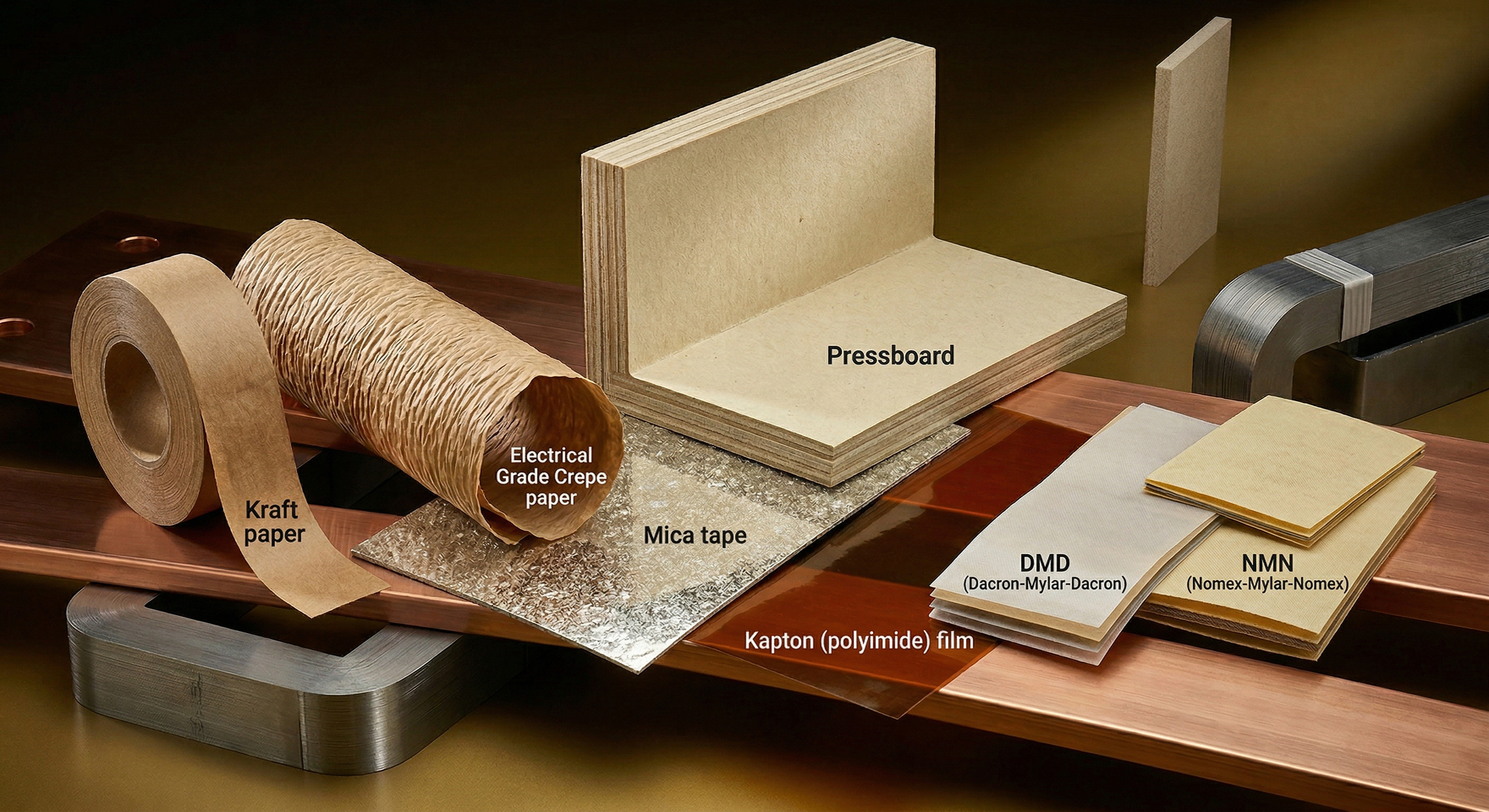
- Electrical Grade Kraft Insulation Paper: Wound directly onto copper conductors in multiple layers. High cellulose purity (90%+) ensures excellent dielectric strength — typically 10–15 kV/mm before oil impregnation. Used in distribution and power transformers from 11 kV to 765 kV.
- Electrical Crepe Paper: Creped texture allows conforming tightly around irregular conductor shapes — terminal leads, tap changer connections, and transformer bushings. Elongation capacity of 100–200% enables wrapping without tearing.
- Pre-Compressed Pressboards: Dense, rigid cellulose boards used as structural spacers, cylinders, angle rings, and winding caps. High-density pre-compressed pressboard withstands the enormous short-circuit electromagnetic forces that act like a hydraulic hammer on transformer windings during fault conditions.
- Densified Laminated Wood (DLW): Beech wood impregnated under vacuum with transformer oil or synthetic resin. Used for clamping structures and core frames where extreme compressive strength and dimensional stability are required.
Where Class A Fails
Without oil cooling, Class A cellulose reaches thermal limits rapidly. Dry-type transformers, air-cooled motors, and any application with ambient temperatures above 40°C combined with high load factors demand moving up to Class B or Class F materials.
2. Class E (120°C) & Class B (130°C) — Epoxy-Enhanced Intermediate Materials
Compact Equipment, Enhanced Resin Systems
As electrical equipment evolved toward more compact designs through the 1970s and 1980s, higher power density in smaller frames created elevated heat concentrations. Class E and Class B filled the gap between cellulose-based Class A and the high-performance composite world of Class F.
Primary Materials — Class E & B
- Polyurethane Enamels (Class E): Applied directly onto copper magnet wire as thin film coatings. Polyurethane enamel provides smooth insulation at thicknesses of 0.02–0.08mm, allowing maximum copper cross-section in tight slot spaces of fractional horsepower motors.
- Epoxy Resin Systems (Class E/B): Cast epoxy encapsulation used in instrument transformers, current transformers (CTs), and voltage transformers (VTs) where moisture resistance and mechanical rigidity must coexist.
- Treated Glass Fiber Mats (Class B): Woven glass fabric saturated with alkyd or polyester resins. Slot liners and phase separators in medium general-purpose industrial motors operating at 380V–690V.
- Melamine Laminates: Hard, rigid sheets used as separator plates in motor terminal boards and small distribution boards.
3. Class F Insulation (155°C) — FRP Laminates, the Heavy-Duty Standard
Most Specified Thermal Class in Modern Industrial Equipment
Class F dominates modern industrial electrical design. At 155°C continuous hotspot rating, Class F materials handle the full thermal load generated by modern high-efficiency motors, variable-frequency drive (VFD) controlled motors, dry-type cast-resin transformers, and switchgear structural components — without relying on liquid cooling. This class marks the transition from organic cellulose to high-performance glass fiber composite laminates.
"Class F epoxy glass laminates combine dielectric withstand voltage exceeding 20 kV/mm with mechanical flexural strength above 400 MPa — performance impossible in any organic insulation material."
Primary Class F Insulation Materials
- G10 / FR4 Epoxy Glass Laminates: Woven glass fabric reinforced with epoxy resin. G10 offers highest mechanical properties; FR4 adds UL94 V-0 flame retardancy. Machined into slot wedges, phase barriers, bus support plates, and structural panels for dry-type transformers and MV switchgear panels. Dielectric strength: 15–20 kV/mm perpendicular to laminate plane.
- DMD (Dacron-Mylar-Dacron) Flexible Laminates: Three-layer composite — polyester nonwoven / polyester film / polyester nonwoven. Flexible, conformable slot liner material for induction motor windings and dry-type transformer layer insulation. Combines excellent puncture resistance with dielectric strength of 8–12 kV/mm.
- Mica Paper Tapes (Glass-Backed): Mica flake paper bonded to woven glass backing, used in high-voltage motor form coils from 3.3 kV upward. Provides corona resistance and arc tracking immunity in addition to Class F thermal performance.
- FRP Pultruded Profiles (Class F): Structural rods, channels, and angles continuously manufactured through pultrusion. Used as slot wedges, winding spacers, and support structures in dry-type transformers and cast-resin distribution units.
Standard Applications — Class F
- Dry-type cast-resin distribution transformers (11 kV, 33 kV)
- High-efficiency IE3 / IE4 induction motors (VFD duty with high dV/dt)
- MV switchgear bus support insulators and phase barriers
- Open-air substations in ambient temperatures up to 50°C
- Wind turbine generator stator insulation systems
4. Class H (180°C) & Class C (200°C+) — Inorganic Materials for Extreme Duty
Traction Motors, Aerospace, Metallurgical Equipment
Class H and Class C deploy entirely when organic and standard composite materials reach their performance ceiling. Class H materials must retain full dielectric and mechanical properties at continuous temperatures that would rapidly carbonize kraft paper or cause DMD laminates to delaminate. These materials dominate demanding sectors: electric railway traction motors, aerospace electrical systems, metallurgical plant drives, and specialized unventilated dry-type transformers.
Primary Class H & C Materials
- Silicone Rubber & Silicone Resins (Class H): Outstanding flexibility retention at 180°C. Silicone-impregnated glass fabric used as slot liners and lead wire insulation in traction motors. Silicone resins used as varnishes for vacuum pressure impregnation (VPI) of high-temperature motor stators.
- NMN (Nomex-Mylar-Nomex) Composites (Class H): Nomex (aramid paper) / Polyester film / Nomex sandwich. Superior dielectric strength of 10–15 kV/mm with thermal endurance at 180°C. Extensively specified in traction motor slot insulation (MRTS, metros, mainline railways) and Class H dry-type transformer winding insulation.
- Polyimide Films — Kapton® (Class C, 220°C+): Synthesized from aromatic monomers, Kapton retains dielectric and mechanical properties from cryogenic temperatures to 220°C continuously. Used in aerospace motor windings, military avionics, and compact hermetically sealed motors where outgassing must be minimized.
- Pure Mica Plates & Segments (Class C): Natural muscovite or phlogopite mica in pure or bonded-plate forms. Zero organic content guarantees thermal stability above 500°C momentarily. Used as commutator segment insulation in large DC machines and as arc barrier plates in high-voltage circuit breakers.
- Ceramic Fiber Systems (Class C): Alumina-silicate fiber blankets, boards, and papers for furnace electrical elements and kiln equipment above 300°C ambient.
How to Select Correct Thermal Class — Engineer's Decision Framework
Wrong thermal class selection ranks among the top causes of premature motor and transformer failure worldwide. Follow a structured approach rather than defaulting to "whatever was used before."
Step 1: Determine Hotspot Temperature
Calculate maximum winding hotspot = ambient temperature + temperature rise by resistance + hotspot allowance (typically +15°C above average winding rise).
Step 2: Apply Safety Margin
Add 10–15°C thermal safety margin to calculated hotspot. Never select a class whose rated limit equals calculated hotspot — material must operate comfortably below its ceiling.
Step 3: Consider Cooling Method
Oil-cooled → Class A viable. Air-cooled → minimum Class F. Forced-air or VFD duty with harmonic currents → Class F mandatory, consider Class H.
Step 4: Environmental Conditions
Coastal / humid / chemical environments require dielectric stability under moisture. Glass composites (Class F+) maintain dielectric properties; cellulose (Class A) absorbs moisture and degrades without oil impregnation.
Step 5: Voltage Class Requirement
Higher voltage classes demand higher dielectric withstand. Above 3.3 kV, mica-based or epoxy glass systems provide the required dielectric strength (15–20 kV/mm) that organic materials cannot sustain.
Step 6: Expected Service Life
Higher thermal class at same operating temperature dramatically extends service life. Specifying Class F where Class B would technically suffice yields 3–5× longer insulation life — reducing maintenance cycles and total cost of ownership.
Complete Reference Table — IEC 60085 Thermal Classes
| Class | Max Hotspot Temp | Typical Materials | Primary Applications |
|---|---|---|---|
| A | 105°C | Kraft Paper, Crepe Paper, Pressboards, DLW | Oil-filled power & distribution transformers |
| E | 120°C | Polyurethane Enamels, Epoxy Resins, Melamine | Fractional HP motors, instrument transformers |
| B | 130°C | Treated Glass Mats, Polyester Laminates | General industrial motors, small dry transformers |
| F | 155°C | G10/FR4 Epoxy Glass, DMD, FRP Profiles, Mica Tape | Dry-type transformers, MV switchgear, VFD motors, wind turbines |
| H | 180°C | Silicone Composites, NMN (Nomex-Mylar-Nomex), High-Temp Mica | Traction motors, metro & railway, unventilated dry transformers |
| C | >200°C | Pure Mica, Polyimide (Kapton), Ceramic Fibers | Aerospace, metallurgical drives, furnace equipment |
Why Material Consistency Matters as Much as Material Class
Specifying the correct thermal class opens the door — but sourcing material that consistently meets that specification batch after batch closes the deal. Sub-standard laminates may pass an initial dielectric withstand voltage test (DIWV) in a lab environment but will rapidly degrade under continuous thermal cycling. Premature partial discharge (PD) onset, rising dissipation factor (tan δ), and eventual inter-turn faults follow predictably.
At ACC Insulations, manufacturing spans the full IEC 60085 thermal spectrum — Class A cellulose pressboards for 400 kV power transformers through to Class F machined G10/FR4 components for 33 kV dry-type switchboards. Every production batch undergoes rigorous dielectric testing, thermal ageing verification, and dimensional inspection before dispatch — ensuring equipment built with ACC Insulations materials achieves its full designed service lifespan, not a fraction of it.
Insulation Engineering Tools
Calculate Arrhenius thermal degradation rates, verify Class A–H IEC 60085 compliance, estimate hotspot temperatures, and determine correct dielectric clearances for your specific application.
Select & Source Correct Thermal Class Materials
ACC Insulations supplies a complete IEC 60085-compliant portfolio — Kraft papers, pre-compressed pressboards, G10/FR4 epoxy laminates, NMN composites, and high-temperature mica materials. Precision-fabricated to your drawing, delivered with full test certificates.
Consult a Thermal Insulation Expert