
NEMA G11 · IEC EPGC 202 · Class F Electrical Insulation — Maharashtra, India
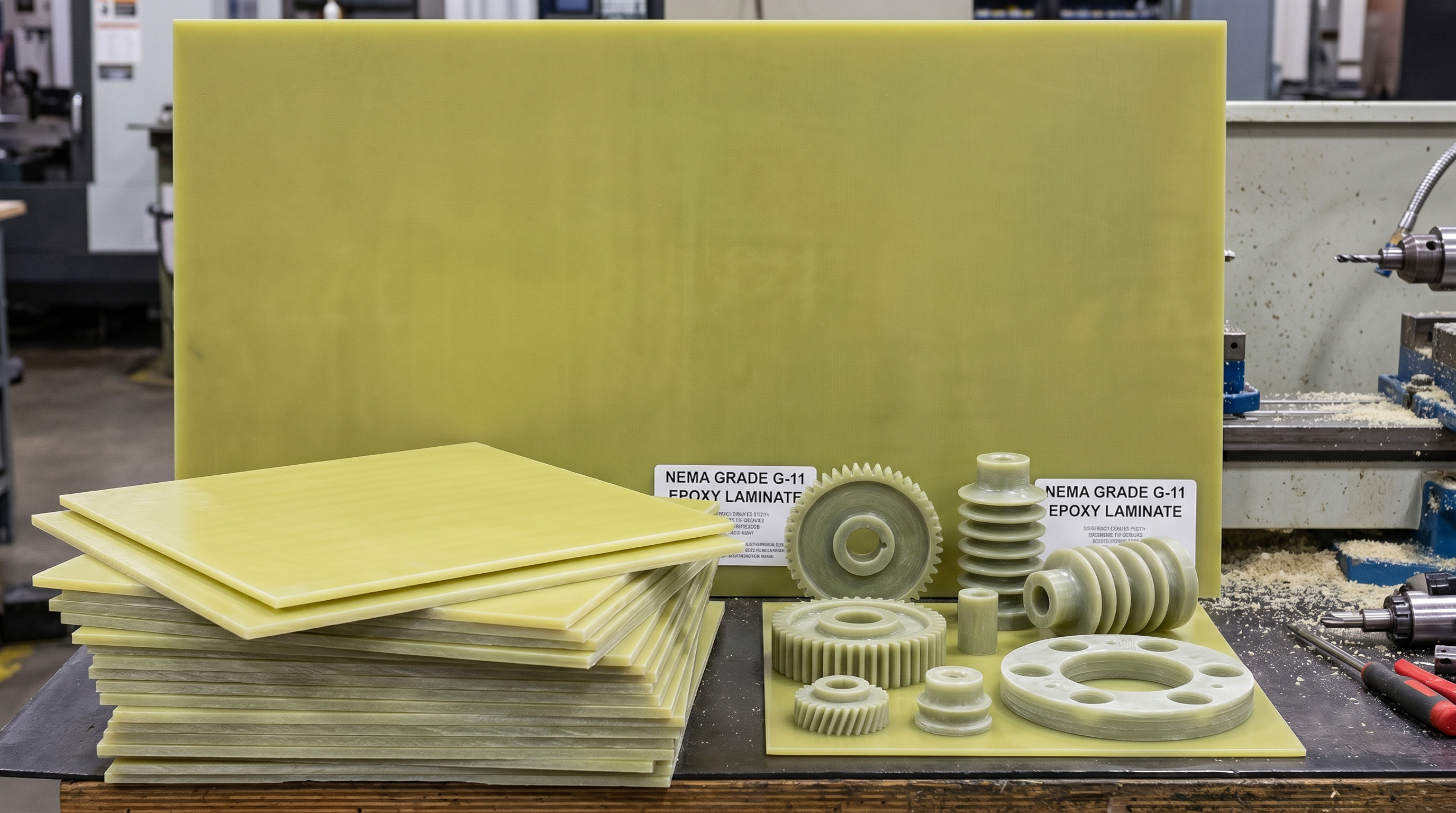
G11 Epoxy Laminate Sheet
G11 epoxy laminate — also designated IEC EPGC 202, IS 3258 EPGC 202, or high-temperature glass epoxy sheet — is a woven E-glass cloth reinforced thermosetting epoxy composite manufactured using an elevated-temperature epoxy resin system. G11's defining property separates it from every other glass epoxy grade: full retention of mechanical flexural and compressive strength above 130°C through to 155°C continuous service temperature.
ACC Insulations manufactures premium electrical-grade G11 epoxy laminate sheets Component in Maharashtra and CNC machines custom insulation components — transformer spacers, motor slot wedges, switchgear phase barriers, and coil support structures — to OEM drawings and IEC/IS tolerances.

G11 Epoxy Laminate — Full Technical Specifications
| G11 Epoxy Laminate (EPGC 202) — Complete Technical Data | |
|---|---|
| NEMA Grade | G11 |
| IEC Designation | EPGC 202 (IEC 60893 Type EP GC 202) |
| Indian Standard | IS 3258 — EPGC 202 |
| Reinforcement | Woven E-Glass Fibre Fabric (alkali-free glass cloth) |
| Resin System | Elevated-Temperature Epoxy Resin (thermosetting — higher Tg than G10/FR4) |
| Thermal Class | Class F — 155°C continuous service temperature |
| Key Differentiator | Retains full mechanical flexural and compressive strength above 130°C — G10 and FR4 soften and lose strength at this threshold |
| Thickness Range | 0.5 mm to 150 mm (custom available) |
| Sheet Lengths | 1000 mm and 1200 mm (custom lengths available) |
| Colours Available | Natural / Black / Red / Green |
| Density | 1.9 – 2.0 g/cm³ |
| Water Absorption | 20 mg (IEC 60893 method D24/23) |
| Flame Retardancy | Not UL 94 V-0 rated (standard G11) — specify FR5 for simultaneous flame retardancy and Class F performance |
| Dielectric Strength | High — meets IEC 60893 EPGC 202 requirements |
| Machinability | Excellent — CNC routing, milling, drilling, turning |
| Standards | IEC 60893, NEMA LI-1, IS 3258, IEC 60085 |
What Is G11 Epoxy Laminate?
G11 epoxy laminate is a high-performance composite structural insulation material produced by stacking multiple plies of woven alkali-free E-glass fibre fabric, impregnating them with an elevated-temperature thermosetting epoxy resin, and curing the assembly under heat and pressure in a hydraulic press. The elevated-temperature resin system used in G11 has a fundamentally higher glass transition temperature (Tg) than the standard epoxy resins used in G10 and FR4 — which defines G11's critical mechanical advantage above 130°C.
At room temperature, G11 and G10 laminates appear nearly identical in stiffness and strength. The critical difference only manifests under heat: above 130°C, G10 and FR4 resin matrices cross the glass transition and begin to soften, losing compressive and flexural rigidity progressively. G11's elevated-temperature epoxy stays well below its glass transition at the same operating conditions — maintaining full mechanical properties through 155°C continuous service. In transformer and motor applications where winding insulation sees 140°C–155°C at rated load, this difference determines whether spacers hold dimensional accuracy over 25+ years of service or creep and compress, allowing winding turns to shift.
G11 in Context — How It Compares to Other Grades
G11 occupies a specific and non-interchangeable position in the epoxy laminate grade family. Understanding what each grade does — and where each fails — prevents costly specification errors:
Standard Temperature Grade
Standard epoxy resin. Excellent room-temperature dielectric and mechanical properties. Softens above 130°C. Correct for terminal boards, electrical panels, jigs, and room-temperature structural insulation. Never specify where G11 is drawn.
High-Temperature Grade — This Page
Elevated-temperature epoxy resin. Retains full mechanical strength above 130°C through 155°C. Mandated for transformer spacers, motor slot wedges, hot switchgear phase barriers, and any structural insulation in sustained high-temperature service.
Flame Retardant Grade
Standard epoxy + flame retardant chemistry. UL 94 V-0 rated. Same thermal limitation as G10 — softens above 130°C. Correct for PCB substrates, switchgear panels requiring fire rating, and all UL94 V-0 applications at ambient to moderate temperature.
High-Temp Flame Retardant
G11-class elevated-temperature epoxy + UL 94 V-0 flame retardancy. Correct where both Class F thermal performance and UL94 V-0 compliance are simultaneously required. High-MVA transformer and HV switchgear applications with fire safety requirements.
Indian Standard — General Grade
IS designation equivalent to G10/FR4 class. Widely specified in Indian OEM drawings. Standard-temperature applications. Not interchangeable with EPGC 202 (G11) — check drawing specification carefully before ordering.
Indian Standard — This Grade
IS 3258 / IEC 60893 designation for G11 class. EPGC 202 and G11 are the same material specification. When an Indian transformer OEM drawing specifies EPGC 202, G11 laminate is the correct material to supply.
Full Grade Comparison Table
Use this table to confirm G11 / EPGC 202 for your application:
| Grade | Thermal Class | Flame Rating | Strength >130°C | IS Equivalent | Correct Application |
|---|---|---|---|---|---|
| G10 | Class B (130°C) | Not rated | Softens >130°C | EPGC 201 | Terminal boards, room-temp insulation |
| G11 ← This Grade | Class F (155°C) | Not V-0 rated | Full strength retained | EPGC 202 | Transformer spacers, motor wedges, hot switchgear |
| FR4 | Class B (130°C) | UL94 V-0 | Softens >130°C | EPGC 201 | PCB, switchgear arc barriers, fire-rated panels |
| FR5 | Class F (155°C) | UL94 V-0 | Full strength retained | EPGC 202 (FR) | HV switchgear + flame rating simultaneously required |
| EPGC 201 | Class B–F | As specified | Standard temp | G10 / FR4 class | Indian OEM standard drawings — room temp |
| EPGC 202 ← This Grade | Class F (155°C) | As specified | Full strength retained | G11 class | Indian OEM transformer & switchgear — high-temp duty |
Why G11 Retains Strength Where G10 Fails — The Physics
The mechanical difference between G11 and G10 at elevated temperature traces directly to epoxy glass transition temperature (Tg). Below Tg, an epoxy resin exists in a glassy state — rigid, high-modulus, capable of carrying compressive and flexural loads. Above Tg, the resin transitions to a rubbery state — the polymer chains gain mobility, stiffness collapses, and compressive creep begins.
- G10 / FR4 epoxy Tg: Approximately 120–130°C. At 140°C operating temperature — well within normal transformer winding temperatures — G10 epoxy runs above its glass transition. Spacer compressive modulus drops significantly. Under continuous load, spacers compress by several percent over months, allowing winding conductors to shift and reducing dielectric clearances.
- G11 epoxy Tg: Significantly higher — well above 155°C. At 140°C operating temperature, G11 epoxy remains firmly in its glassy state. Compressive modulus stays near room-temperature values. Spacers retain dimensional accuracy across the transformer's rated service life without creep.
- Why this matters in transformers: A transformer specified for 155°C Class F service carries winding temperatures at rated load that G10 cannot survive without dimensional failure. IEC 60076 and major OEM transformer designs mandate EPGC 202 (G11) spacers precisely because G10 creep failure under hot compressive load is a documented failure mechanism — not a theoretical risk.
Available Colours
G11 epoxy laminate sheets available in four standard colours. Colour coding assists component identification during transformer or motor assembly and helps differentiate G11 from G10 stock in fabrication workshops:
Colour does not affect electrical or mechanical performance. Custom colour requests available on enquiry. Colour assists workshop identification of G11 vs G10 stock — critical where both grades are held in the same fabrication facility.
Thickness Range: 0.5 mm to 150 mm
G11 epoxy laminate supplied across the complete thickness range required in electrical engineering — from thin inter-layer barriers to heavy structural blocks for CNC machining:
Thin Sheets
Inter-layer insulation barriers, slot cell liners, winding separator strips
Standard Sheets
Phase barriers, terminal boards, switchgear panel insulation, motor coil formers
Medium Sections
Transformer spacers, coil clamping rings, structural supports, arc barriers
Heavy Sections
CNC-machined mechanical components, HV bushing support plates, heavy structural insulators
Key Electrical & Mechanical Properties of G11
Applications of G11 Epoxy Laminate
G11 (EPGC 202) is specifically mandated — not merely preferred — for every application where structural insulation components carry sustained mechanical loads above 130°C:
Why G11 Outperforms G10 and FR4 in High-Temperature Service
Mechanical Strength Retained Above 130°C
G11's elevated-temperature epoxy stays below glass transition at 155°C operating conditions. Compressive modulus, flexural rigidity, and creep resistance remain near room-temperature values — G10 and FR4 collapse progressively above 130°C under the same load.
Dimensional Stability Over Service Life
G11 transformer spacers hold dimensional accuracy across 25–30 years of continuous high-temperature service. G10 spacers at 140°C creep by measurable percentages over months, reducing winding clearances and eventually causing inter-turn contact failures.
Low Moisture Absorption
20 mg water absorption (IEC 60893 D24/23) — identical to G10, but maintained at sustained elevated operating temperatures. Stable moisture behaviour ensures dielectric strength remains constant in humid transformer environments and oil-immersed applications.
Chemical and Oil Resistance
G11's cross-linked elevated-temperature epoxy matrix resists transformer mineral oil, synthetic esters, solvents, and mild acids — maintaining full mechanical and dielectric properties throughout oil-immersed transformer service at rated temperature.
Excellent CNC Machinability
G11 machines cleanly with CNC routers, mills, and drills — producing tight-tolerance components, clean drilled holes, and smooth profiles. Its slightly harder matrix compared to G10 actually delivers cleaner machined edges in precision spacer and wedge production.
IEC 60076 and OEM Compliance
Major transformer OEM specifications and IEC 60076 transformer standards mandate EPGC 202 (G11) for winding insulation components in Class F transformers. Using G11 keeps your design compliant with customer engineering standards without deviation requests.
Manufacturing Process
G11 epoxy laminate manufactured through a controlled multi-stage hot-press lamination process optimised specifically for elevated-temperature resin systems:
- Alkali-free E-glass fabric selection: Woven E-glass fabric selected to specified areal weight and weave pattern. Glass sizing chemistry matched to the elevated-temperature epoxy resin for maximum fibre-matrix adhesion at high operating temperatures.
- Elevated-temperature resin impregnation: Glass fabric plies impregnated with G11-grade elevated-temperature epoxy resin — formulated for high Tg. Resin content controlled to achieve target density (1.9–2.0 g/cm³) and mechanical strength.
- Layup and stacking: Resin-impregnated plies stacked to required thickness. Ply count calculated for target density and to achieve full mechanical properties after cure.
- Hot-press curing at elevated temperature: Stacked assembly cured in hydraulic hot press at higher temperature than G10/FR4 — typically 150–180°C — to fully cross-link the elevated-temperature epoxy resin. Higher cure temperature ensures complete reaction and maximum Tg in the finished laminate.
- Post-cure and stabilisation: G11 laminates undergo a post-cure thermal stabilisation step that G10 does not require — ensuring dimensional stability and full mechanical property development throughout the sheet thickness.
- Sheet cutting and surface finishing: Cured panels cut to standard or custom sheet sizes, surface finished, and inspected for thickness uniformity and surface quality.
- CNC machining (optional): Custom insulation components — transformer spacers, slot wedges, phase barriers, coil clamps — machined from G11 sheet blanks to customer drawings with tight tolerances.
- Quality verification: Each batch tested for thickness, density, dielectric strength, and water absorption before release. IS 3258 / IEC 60893 EPGC 202 test certificates on request.
Standards & Compliance
- IEC 60893 — Thermosetting laminates for electrical purposes — Type EP GC 202 (G11 designation)
- NEMA LI-1 — National Electrical Manufacturers Association industrial laminate standard (G11 grade definition and property requirements)
- IS 3258 — Indian Standard for glass fibre reinforced laminates — EPGC 202 designation
- IEC 60085 — Thermal classification of electrical insulation — Class F (155°C) rating
- IEC 60664 — Insulation coordination for equipment within low-voltage systems
- IEC 60076 — Power transformers — specifies insulation material requirements for Class F transformer winding components
Industries Served with G11 Epoxy Laminate
- Power transformer manufacturing — EPGC 202 winding spacers, disc insulation, coil end clamps, bushing support plates for Class F oil-immersed transformers
- Distribution transformer manufacturing — G11 spacer blocks and inter-layer insulation for high-ambient or high-load distribution transformer designs
- Electric motor manufacturing — G11 slot wedges, end ring insulation, and support plates for Class F and Class H rotating machines
- Switchgear & HV equipment manufacturing — G11 phase barriers and structural insulators for switchgear rated for high-ambient enclosure temperatures
- Railway & traction — EPGC 202 insulation components for traction transformer and auxiliary converter equipment
- Renewable energy (solar & wind) — High-ambient transformer insulation in tropical and desert solar installations, nacelle transformer components
- Industrial furnace & rectifier transformers — G11 insulation for arc furnace, induction furnace, and electrochemical rectifier transformers at elevated duty temperatures
Engineering Tools Suite
Calculate thermal class requirements, dielectric clearances, and confirm G11 vs G10 grade selection for your specific application temperature, voltage class, and mechanical load requirements.
Frequently Asked Questions
G11 epoxy laminate uses an elevated-temperature epoxy resin system formulated with a higher glass transition temperature (Tg) than the standard resin used in G10. Both grades use identical woven E-glass cloth reinforcement. At room temperature, G11 and G10 perform nearly identically in dielectric and mechanical properties. Above 130°C — the critical threshold — G10's resin crosses its glass transition and begins softening, losing compressive and flexural rigidity progressively. G11's elevated-temperature resin remains well below its Tg at 140°C–155°C operating conditions, maintaining full mechanical strength. G11 carries IEC EPGC 202 and IS 3258 EPGC 202 designations and Thermal Class F (155°C) rating. Using G10 where G11 is specified risks dimensional creep failure of spacers and wedges above 130°C.
Yes. EPGC 202 (IEC 60893 Type EP GC 202 and IS 3258) is the international and Indian Standard designation for G11 class epoxy glass cloth laminate. EP = epoxy resin system, GC = glass cloth reinforcement, 202 = elevated-temperature property class distinguishing it from EPGC 201 (the G10/FR4 equivalent). When an Indian transformer or switchgear OEM drawing specifies EPGC 202, G11 laminate is the correct material to supply. ACC Insulations stocks both as G11 and EPGC 202 and supplies IS-compliant material certificates with each batch.
No. FR4 lacks G11's high-temperature mechanical strength — FR4 uses a standard-temperature epoxy rated Class B (130°C) that softens above that threshold. If an application requires both Class F (155°C) high-temperature strength and UL 94 V-0 flame retardancy simultaneously, the correct specification is FR5 — not G11 and not FR4. FR5 combines G11-class elevated-temperature epoxy with UL 94 V-0 flame-retardant chemistry. ACC Insulations manufactures FR5 Component and can advise on grade selection for specific application requirements.
G11 epoxy laminate available from 0.5 mm to 150 mm thickness across all standard sheet lengths (1000 mm and 1200 mm). In-house CNC machining produces custom G11 components — transformer spacers, motor slot wedges, phase barriers, coil clamping rings, bushing support plates, and precision-profiled structural insulation parts — from G11 sheet blanks to customer CAD drawings. Custom lengths and widths available on enquiry.
Yes. G11 machines cleanly using CNC routing, milling, drilling, and turning. Its elevated-temperature epoxy matrix is slightly harder than G10 — this actually delivers cleaner machined edges, especially on fine-tolerance spacer profiles and drilled holes. ACC Insulations operates CNC machining equipment specifically for G11 and EPGC 202 component production: transformer spacers, slot wedges, terminal boards, arc chutes, bushing support plates, coil clamp segments, and custom-profiled structural parts per customer CAD drawings and IS/IEC tolerances.
Transformer winding temperatures at rated load reach 100°C–155°C in Class F designs. G11 (EPGC 202) spacers inside the winding carry compressive loads at these temperatures continuously for 25–30 year service lives. G10 spacers at 140°C–155°C operate above their glass transition temperature — the resin softens and spacers compress under load by several percent over months. This reduces disc-to-disc clearances, compresses inter-layer oil channels reducing cooling, and allows winding conductors to shift — a documented primary failure mechanism in transformers specified with incorrect insulation grades. G11 spacers hold full dimensional accuracy at rated temperature throughout service, maintaining winding geometry and preventing this failure mode.
G11 epoxy laminate shows a water absorption of 20 mg tested per IEC 60893 method D24/23 (24 hours immersion at 23°C) — identical to G10 and FR4. This low value ensures dielectric strength remains stable in humid environments and under oil immersion at elevated operating temperatures. G11's elevated-temperature epoxy cross-link density also contributes to better long-term moisture resistance at sustained high temperatures compared to standard-temperature epoxy grades.
Request a Quote
Get pricing & datasheet within 24 hours