EV Motor Insulation Materials
The traction motors inside battery electric vehicles (BEVs) and hybrid electric vehicles (HEVs) operate under conditions that completely exceed what standard industrial motor insulation can handle. High-voltage inverters — now predominantly based on Silicon Carbide (SiC) power semiconductors — switch at frequencies up to 50 kHz, creating voltage rise rates (dV/dt) that generate severe partial discharge stress across every turn of the stator winding.
Combined with peak operating temperatures of 180°C to 220°C, mechanical stress at 10,000–20,000 RPM, and exposure to dielectric cooling oils, the EV traction motor is the most demanding insulation environment in modern electromechanical engineering.
ACC Insulations manufactures and custom-fabricates EV-grade insulation materials in India — Aramid papers, Polyimide films, NMN/NHN composite laminates, and high-temperature epoxy components — engineered specifically for these conditions.
Why Specialized EV Insulation Is Non-Negotiable: Standard pressboard and basic varnish systems fail within months in SiC-driven traction motors. Partial discharge erodes enamel insulation until turn-to-turn faults cause catastrophic winding failure. Only corona-resistant, high-temperature materials rated for inverter-driven duty can achieve the required 15+ year service life.

Why Standard Motor Insulation Fails in EV Traction Motors
Four specific engineering challenges make EV traction motor insulation a completely different problem from conventional industrial motor insulation.
SiC Inverter Voltage Spikes
Silicon Carbide (SiC) and IGBT inverters switch battery voltage (400–800V DC) at speeds up to 50 kHz, creating voltage rise rates of up to 10 kV/μs. These steep voltage pulses concentrate stress at every turn of the winding and rapidly erode standard enamel insulation through partial discharge.
Demands corona-resistant materialsExtreme Thermal Load
EV traction motors operate continuously at 150–180°C with frequent peaks above 200°C during fast acceleration or sustained motorway driving. Standard Class F (155°C) industrial insulation has no thermal margin at these conditions and ages at an accelerated rate.
Demands Class H to Class C materialsHigh-Speed Mechanical Stress
Traction motors spin at 10,000–20,000 RPM in service. At these speeds, centrifugal forces on the winding end-turns and slot wedges are orders of magnitude higher than in standard industrial motors, requiring insulation materials with exceptional mechanical strength and dimensional stability.
Demands high-strength compositesOil / Coolant Compatibility
Many EV motor designs use direct oil cooling — ATF or specialised dielectric cooling fluid is pumped directly over or through the stator. Every insulation material in the motor must maintain its dielectric and mechanical properties when continuously immersed in these fluids at elevated temperature.
Demands chemical-resistant materialsEV-Grade Insulation Materials We Supply
Each material below addresses a specific layer of the EV motor insulation system. Understanding which material goes where is the key to designing a reliable, long-life traction motor.
Aramid Paper (Nomex-Equivalent)
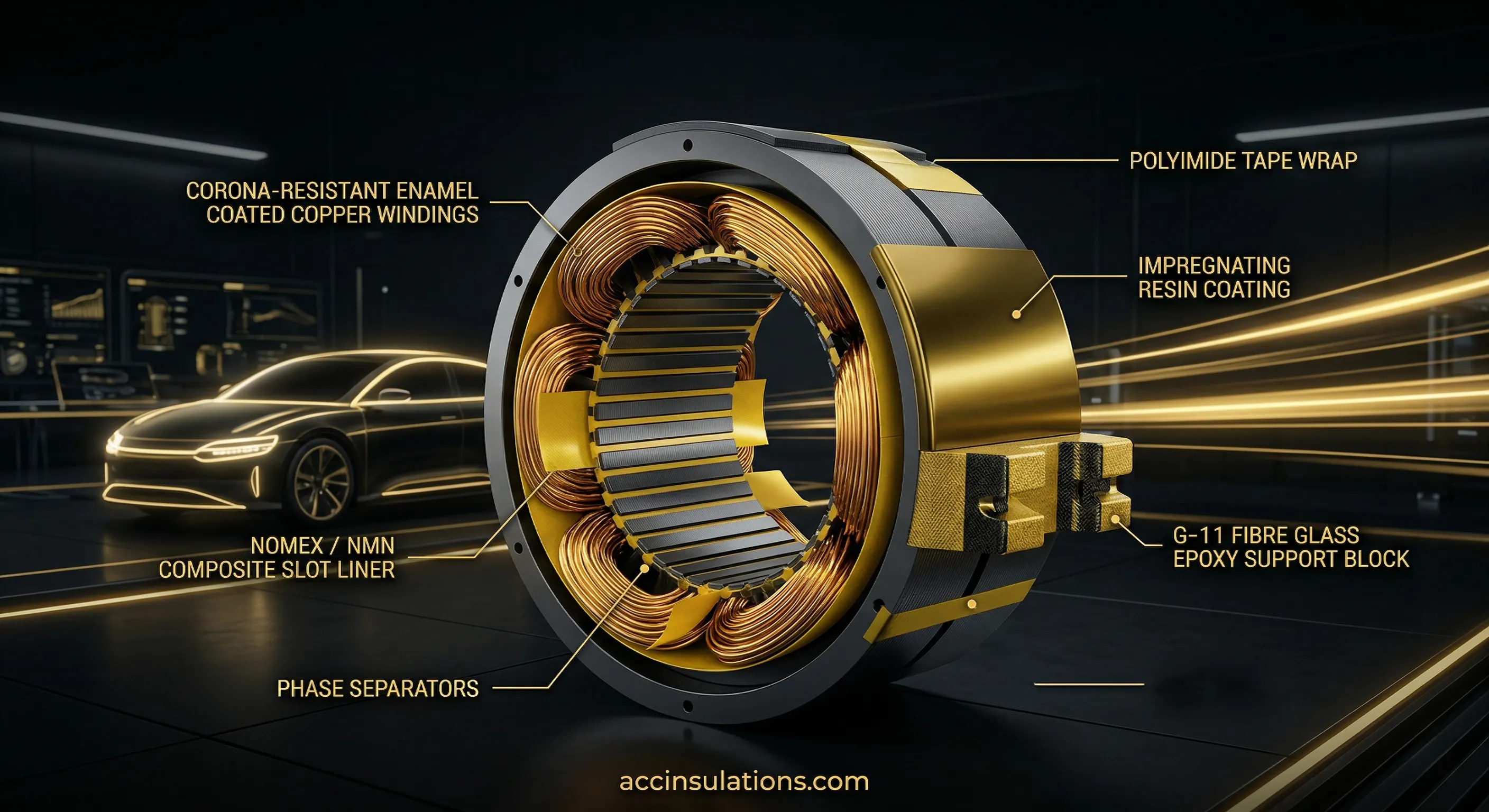
Class H — 180°CThe workhorse of EV slot insulation. Aramid paper provides inherent corona resistance, excellent flexibility for slot liner forming, and outstanding thermal stability. It does not melt or flow at rated temperature — it chars, maintaining its insulating barrier. Used as flat slot liners, phase separators, and end-winding insulation.
- Inherently corona-resistant — no erosion from partial discharge
- Excellent oil and coolant resistance
- Flexible for pre-formed U-channel slot liners
- Good tear strength — handles automated winding insertion
Polyimide Film (Kapton-Equivalent)
Class C — 220°C+Polyimide film delivers the highest thermal class of any organic insulation material available. It maintains dielectric strength and dimensional stability from cryogenic temperatures to above 240°C — ideal for extreme duty traction motors and aerospace propulsion systems where standard Aramid is insufficient.
- Highest thermal class of any organic dielectric film
- Extreme dielectric strength — >20 kV/mm
- Excellent corona and partial discharge resistance
- Used in aerospace, motorsport, and heavy traction
NMN & NHN Composite Laminates
Class H to Class CNMN (Nomex-Mylar-Nomex) and NHN (Nomex-Hostaphan-Nomex) are three-layer composite laminates combining Aramid paper faces with a Polyester or Polyimide film core. The result is a material that combines corona resistance, high dielectric strength, tear resistance, and stiffness — ideal for hairpin wound EV stators.
- Higher dielectric strength than Aramid paper alone
- Superior stiffness for automated slot liner insertion
- Preferred material for hairpin winding EV motors
- Excellent combination of flexibility and strength
Fibre Glass Epoxy (G10/G11/FR5)
Class F to Class HCNC-machined from high-temperature G11 or FR5 epoxy laminate, these rigid components provide the mechanical backbone of the slot — slot wedges, phase separators, terminal blocks, and lead wire bracing. The epoxy matrix maintains dimensional stability at high temperature and resists the vibration loads of high-speed traction motors.
- CNC machined to ±0.05 mm — fits precisely in slot
- High compressive strength — retains conductors at 20,000 RPM
- Oil and coolant compatible
- G11/FR5 maintains strength at Class H temperatures
Silicone-Coated Glass Fibre Tubing
Class H to Class CFlexible glass fibre tubes with silicone rubber coating provide insulation and mechanical protection for lead wires exiting the winding and for interconnection cables within the motor. The silicone coating maintains flexibility at low temperature and resists oil exposure at elevated temperature.
- Flexible at -60°C, stable to 220°C+
- Oil and coolant resistant silicone coating
- Available in any bore diameter and cut length
- Fire retardant grades available
Phase Separators & End-Turn Supports
Class HFlat Aramid or NMN sheet barriers placed between phases in the end-turn region prevent phase-to-phase contact under the electromagnetic forces of EV motor starting currents (which can reach 3–5× rated current). End-turn support brackets machined from epoxy laminate prevent winding movement under high-speed vibration.
- Prevents phase-to-phase shorts under surge current
- Dimensional stability to 180°C under mechanical load
- Available in custom profiles for any stator geometry
- Compatible with VPI resin impregnation
Hairpin vs Round Wire Winding — How Winding Type Affects Insulation Choice
The two dominant EV traction motor winding architectures have fundamentally different insulation requirements. Understanding the difference is critical to selecting the right slot liner material.
Hairpin (Bar Wound) Winding
Hairpin windings use pre-formed flat rectangular copper conductors (bars) inserted into the stator slots. The flat bar geometry achieves a copper fill factor of 60–75%, significantly improving power density and thermal conductivity compared to round wire.
However, the flat conductor surfaces sit in very close proximity within the slot — often separated by only the slot liner material. This concentrates the electric field at the conductor edges, making corona resistance the single most critical property of the slot liner material in hairpin EV motors.
Preferred insulation: NMN or NHN composite laminates, or Polyimide film — both offer superior corona resistance and the stiffness required for automated bar insertion.
Round Wire (Random Wound) Winding
Round wire windings use conventional round copper wire wound into the stator slots using automated winding machines. The random (non-controlled) arrangement of conductors in the slot gives a lower copper fill factor (40–50%) compared to hairpin, but the manufacturing process is faster and lower cost.
In round wire windings, the circular conductor geometry distributes the electric field more uniformly around the conductor surface, reducing the peak field stress at any single point. This means corona resistance, while still important, is less critical than in hairpin windings.
Preferred insulation: Aramid paper (NMN) slot liners remain the standard choice — providing excellent thermal performance, corona resistance, and the flexibility needed for automated insertion.
ACC Insulations supplies insulation materials optimised for both winding types. When enquiring, please specify whether your motor uses hairpin or round wire winding — this determines whether we recommend Aramid paper, NMN composite, or Polyimide film as the primary slot liner material for your application.
Material Specifications
| EV Motor Insulation Materials — Technical Data | |
|---|---|
| Material Types | Aramid Papers (Nomex-equivalent), Polyimide Film (PI/Kapton-equivalent), NMN / NHN Composite Laminates, Fibre Glass Epoxy (G10/G11/FR5) |
| Thermal Class | Class H (180°C) up to Class C (220°C+) |
| Dielectric Strength | >20 kV/mm (material dependent) |
| Corona Resistance | High — suitable for SiC and IGBT inverter-driven traction motors |
| Inverter Compatibility | SiC-based and IGBT-based high-frequency inverters (up to 50 kHz switching) |
| Winding Compatibility | Hairpin (bar wound) and round wire (random wound) stators |
| Cooling Compatibility | Air-cooled, oil-cooled (ATF, dielectric fluid compatible) |
| Speed Rating | Up to 20,000 RPM (slot wedge and support components) |
| Available Forms | Flat sheets, pre-formed slot liners, die-cut profiles, CNC-machined wedges, glass fibre tubing |
| Standards | IEC 60085, IEC 60034, UL 94-V0 (flame retardant grades) |
Key Performance Features
- Extreme thermal stability up to 220°C+ — Class H and Class C materials maintain mechanical and dielectric integrity through continuous high-load EV operation, without softening, melting, or losing insulation resistance
- Superior corona resistance for SiC inverter systems — Aramid, Polyimide, and NMN/NHN materials do not erode under partial discharge from SiC high-dV/dt switching, providing the insulation life that the EV powertrain design demands
- High thermal conductivity — selected composite materials improve heat transfer from the winding conductors to the stator core, enabling higher continuous current ratings within the same frame size
- Exceptional mechanical resilience at high speed — rigid epoxy slot wedges and end-turn supports maintain conductor retention at 15,000–20,000 RPM throughout the motor's service life
- Chemical resistance to ATFs and dielectric cooling fluids — verified compatibility with modern EV cooling oils used in direct oil-cooled stator designs
- Flame retardant — UL 94-V0 rated grades available — critical for battery electric vehicle safety compliance
- VPI process compatible — all materials are compatible with standard vacuum pressure impregnation resins used to void-fill and seal the complete winding
Comprehensive EV Material Solutions — Layer by Layer
ACC Insulations supplies materials for every insulation layer of the EV traction motor stator:
Layer 1 — Slot Liners and Phase Separators: The ground wall insulation between stator conductors and the iron core. We supply Aramid paper, NMN, and NHN composite laminates as flat or pre-formed slot liners — cut to your exact stator slot geometry with precision die-cutting services. For hairpin winding designs, NMN/NHN is recommended for its superior corona resistance and stiffness for automated bar insertion.
Layer 2 — Turn and Interlayer Insulation: Within multi-layer round wire windings, thin Aramid or NMN sheets separate winding layers to prevent inter-layer voltage breakdown. In hairpin designs, the individual bar coating (enamel) provides turn-to-turn insulation, but the slot liner must compensate for this by delivering adequate ground wall strength.
Layer 3 — Structural Slot Wedges: CNC-machined from G11 or FR5 fibre glass epoxy laminate to your exact slot opening dimensions. The wedge retains copper conductors against centrifugal forces at high RPM and must maintain dimensional stability at peak operating temperatures without loosening.
Layer 4 — End-Turn Phase Barriers and Support Brackets: Insulation barriers and mechanical supports in the end-turn region, fabricated from Aramid sheet or rigid epoxy laminate to your profile. Critical for preventing phase-to-phase contact during high starting current surges.
Layer 5 — Lead Wire Insulation (Silicone Glass Fibre Tubes): Flexible Class H/C insulation sleeving for lead wires and inter-phase connections exiting the winding, providing both electrical insulation and mechanical abrasion protection.
Manufacturing & Customisation
ACC Insulations does not just supply raw sheets — our fabrication facilities deliver ready-to-use components precisely matched to your stator drawing:
- Precision die-cutting — slot liners cut to your exact slot geometry (length, width, leg height, and fold profile) in any Aramid, NMN, or NHN grade
- CNC machining — slot wedges, end rings, terminal blocks, and structural supports machined to ±0.05 mm from G11, FR5, or high-temperature epoxy grades
- Custom slitting — rolls slit to your specified width for in-house slot liner forming or automated winding machine feeding
- Prototype to production — we accept customer drawings and supply from prototype sample quantities through full-volume OEM production runs
Standards & Compliance
- IEC 60085 — Thermal classification of electrical insulation (Class H, Class C)
- IEC 60034 — Rotating electrical machines — insulation requirements for EV-duty motors
- UL 94-V0 — Flame retardancy classification for applicable grades
- MIL-I-24768 Type FBN — Aramid paper grade compliance benchmark
- ASTM D5213 — Polyimide film specification compliance
- OEM-specific material qualification specifications accepted on request
Target Applications
Engineering Tools Suite
Calculate exact dielectric tolerances, thermal stability margins, and insulation thickness requirements for your EV motor insulation design using our interactive engineering tools.
Frequently Asked Questions
Standard industrial motors run on smooth sinusoidal AC from the grid. EV traction motors are driven by SiC or IGBT inverters that switch at very high frequencies, generating steep voltage rise rates that create partial discharge stress across every turn of the winding. These spikes erode standard enamel insulation rapidly. EV motors also run hotter (Class H to C) and at higher speeds (10,000–20,000 RPM) than standard industrial motors, requiring materials with far greater thermal stability and mechanical resilience.
ACC Insulations supplies EV motor insulation materials covering Class H (rated to 180°C continuous) through Class C (220°C+). Aramid paper (Nomex-equivalent) covers Class H. Polyimide film (Kapton-equivalent) covers Class C. For the most extreme traction motor applications — motorsport and aerospace — we can supply materials for peak temperatures exceeding 240°C. Please specify your continuous and peak operating temperatures when enquiring so we can recommend the correct grade.
Corona (partial discharge) is localised electrical breakdown in tiny air voids within the insulation when the local electric field exceeds the air's breakdown strength. In EV motors powered by SiC inverters, the extremely fast voltage switching (dV/dt up to 10 kV/μs) creates voltage spikes that concentrate at voids between turn insulation layers — particularly in hairpin windings. Standard enamel insulation is not corona resistant and erodes under repeated partial discharge until the winding fails. Aramid papers, Polyimide films, and NMN/NHN composite laminates are specifically selected because they do not erode under partial discharge the way organic enamels do.
Hairpin windings use flat rectangular copper bars achieving 60–75% copper fill and better power density. However, flat conductor surfaces sit very close together in the slot, concentrating the electric field at conductor edges — making corona resistance critical. NMN/NHN or Polyimide film is preferred for hairpin motors. Round wire windings use conventional round copper wire with 40–50% fill, better distributing field stress. Aramid paper slot liners are the standard choice. Please specify your winding type when enquiring so we can recommend the optimal slot liner material.
Yes. Our Aramid papers, Polyimide films, and NMN/NHN laminates are chemically resistant to modern ATFs and specialised EV dielectric cooling fluids used in direct oil-cooled stator designs. Compatibility is verified by immersion testing. Please specify your cooling fluid when enquiring — different ATF formulations can vary in chemical aggressiveness, and we can confirm compatibility with your specific fluid.
Yes. ACC Insulations offers precision die-cutting and CNC fabrication services to supply ready-to-insert EV stator slot liners cut to your exact slot geometry — length, width, and fold profile — in any specified material grade (Aramid, Polyimide, NMN, NHN). We supply flat liners, pre-formed U-channel liners, and closed-cell liners for both hairpin and round wire stators, from prototype quantities through full production volumes.
Our EV motor insulation materials comply with IEC 60085 (thermal classification), IEC 60034 (rotating electrical machines), and UL 94-V0 for flame retardant grades. Aramid paper grades comply with MIL-I-24768 Type FBN benchmarks. Polyimide film grades comply with ASTM D5213. Material data sheets and test certificates are available on request.