Electrical Insulation Machined Components — Maharashtra, India
Fiberglass Epoxy Solid Rod
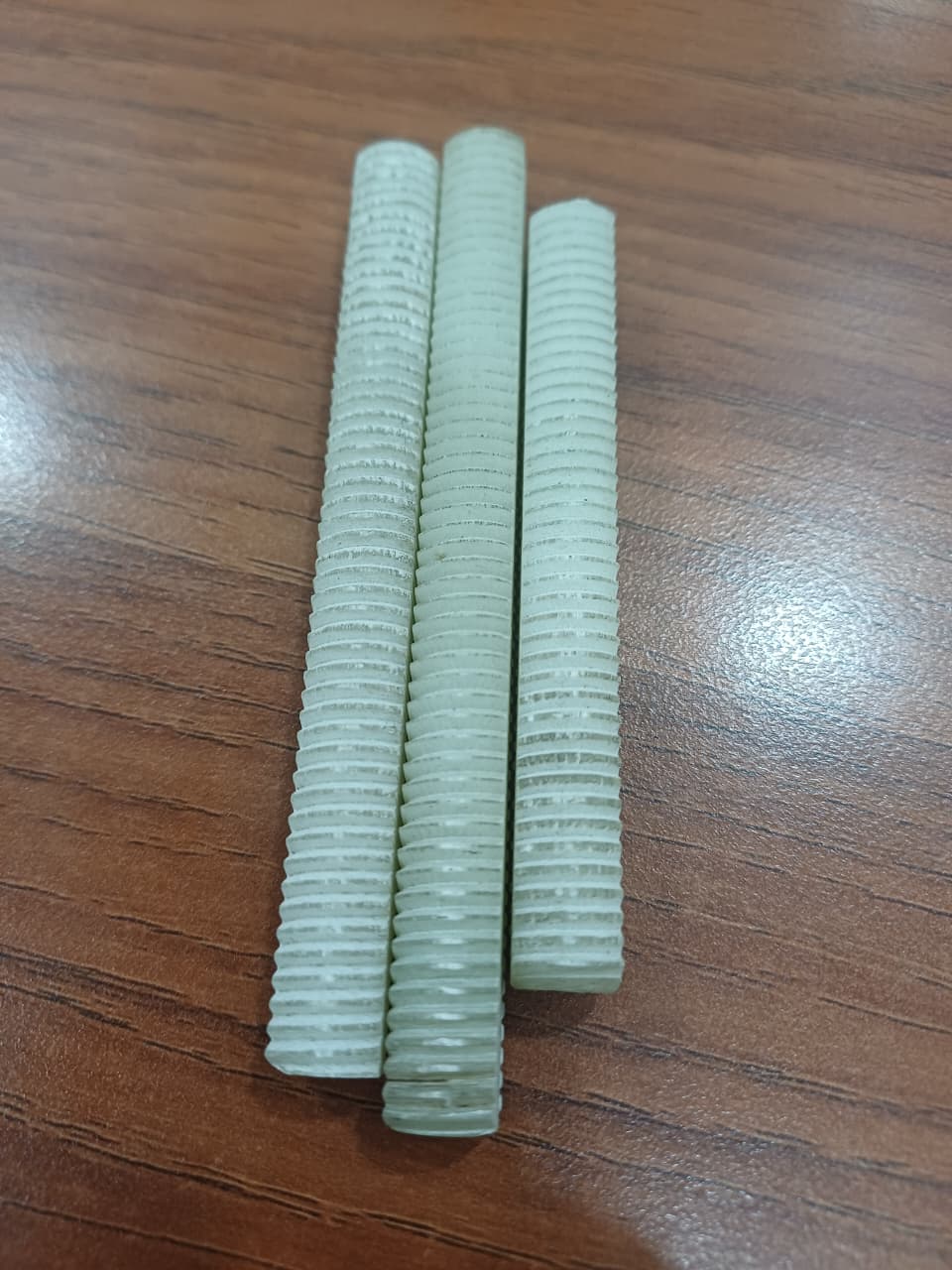
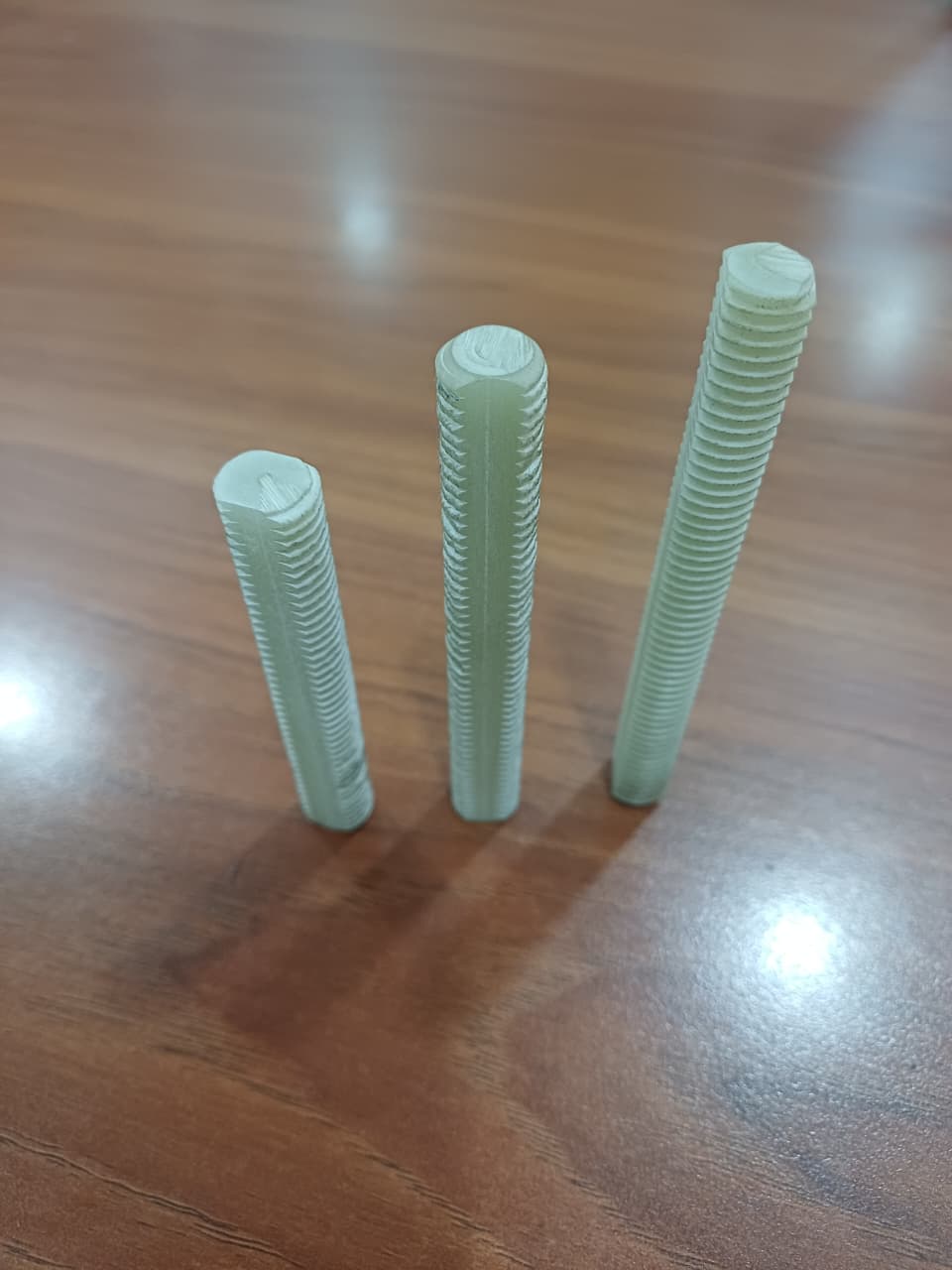
Fiberglass Epoxy Solid Rod — also referred to as insulating tie-rod, composite winding clamp rod, or non-conductive threaded fastener — is a full circular cross-section component precision-machined from glass fibre reinforced epoxy laminate (G10, G11, FR4) or pultruded FRP. The solid cross-section provides the tensile and compressive load capacity required for structural fastening duty — while the glass-epoxy matrix delivers the high dielectric strength and non-magnetic properties essential in HV electrical assemblies.
CNC-turned and threaded to exact customer drawings, these rods are used as composite tie-rods, threaded insulation bolts, winding clamp rods, and structural pins wherever metal fasteners would create short-circuit paths, eddy current losses, or magnetic interference in transformer, switchgear, and motor assemblies. ACC Insulations machines solid rods from certified IEC 60893 and NEMA LI-1 grade stock at our MIDC Ambad, Nashik facility.

Technical Specifications
| Fiberglass Epoxy Solid Rod — Full Technical Data | |
|---|---|
| Product Name | Fiberglass Epoxy Solid Rod — Electrical Grade (G10 / G11 / FR4 / FRP) |
| Cross-Section Form | Full circular (solid) — no void, no hollow core |
| Material Grades | G10 (IEC 60893 EPGC 201) | G11 (IEC 60893 EPGC 203) | FR4 | Pultruded FRP |
| Standard Diameter Range | 6 mm to 100 mm | Custom diameters beyond 100 mm on request |
| Standard Lengths | 1000 mm / 2000 mm standard | Cut-to-exact-length available |
| Threading | Metric M6 – M64 | BSP | UNC / UNF — CNC-turned to specification |
| Dielectric Strength (Transverse) | ≥ 15 kV/mm (G10/G11 grade) |
| Tensile Strength | ≥ 280 MPa (G10 / FR4 grade longitudinal) |
| Flexural Strength | ≥ 350 MPa (G10) | ≥ 380 MPa (G11) |
| Thermal Class | Class F (155°C) with G10 | Class H (180°C) with G11 — based on resin grade |
| Oil Compatibility | Suitable for mineral transformer oil and ester-based dielectric fluids |
| Surface Finish | Smooth CNC-turned (Ra ≤ 1.6 μm standard) or as-pultruded for FRP grades |
| Colour | Yellow-Green (G10) | Natural Yellow (G11) | Green (FR4) |
| Standards | IEC 60893 (G10/G11), NEMA LI-1 Grade G-10 / G-11, IEC 60085, customer-specific |
| Application | Composite tie-rods, threaded insulation bolts, winding clamp rods, structural pins, HV non-conductive fasteners |
What Is a Fiberglass Epoxy Solid Rod?
A fiberglass epoxy solid rod is a high-performance structural insulation component with a full circular cross-section, manufactured from woven glass fibre reinforced epoxy resin laminate (G10, G11, FR4) or pultruded glass fibre reinforced polymer (FRP). The term "solid" distinguishes it from hollow tubes — the entire cross-section is dense, void-free, cured composite material with no internal cavity.
This solid construction is the defining characteristic that enables its use as a fastener and tie-rod material: threads can be cut directly into the rod body by CNC turning, and it can sustain the full compressive and tensile loads generated by bolted clamping systems — something a hollow tube cannot do without risk of crushing or splitting at the thread root.
Full Circular Cross-Section — Why It Matters
The solid circular geometry is not simply a shape — it is a structural requirement driven by the mechanical demands of HV assembly fastening:
Solid Rod — Cross-Section Anatomy
Solid cross-section · No internal void · Full thread engagement · CNC-turned to tolerance
| Structural Feature | Engineering Function | Why It Matters in HV Assemblies |
|---|---|---|
| Full solid circular core | Carries tensile and compressive load across the entire cross-section area | Withstands winding clamp bolt pre-load without compression failure at thread root |
| CNC-cut thread form | Enables direct threaded engagement with nuts, inserts, or tapped components | Replaces steel bolts with a zero-conductivity, non-magnetic fastener in HV zones |
| Glass-epoxy matrix | Provides high dielectric strength through the rod cross-section | Maintains full electrical isolation between clamped HV parts even under load |
| Non-magnetic material | Zero magnetic permeability — no flux distortion, no eddy current path | Safe to locate in transformer core clamp zones where steel would cause losses |
Standard Diameter Grades
ACC Insulations stocks and machines fiberglass epoxy solid rods across a full range of diameters. All sizes are available CNC-turned to tolerance and threaded or cut-to-length to your specification:
Custom diameters beyond 100 mm, intermediate sizes, and non-standard thread forms (BSP, UNC, UNF, trapezoidal) are available on request. All sizes available in G10, G11, FR4, and pultruded FRP grades subject to availability.
Key Performance Properties
How Solid Rods Function in a Transformer Assembly
Understanding the load path and electrical role of solid insulating rods clarifies why material grade and machining quality are both critical:
Core Clamping — Winding Clamp Rods
In transformer core-coil assembly, clamping frames hold the wound coils axially under defined pre-load to control short-circuit axial withstand. The clamping rods running through or around the winding must be electrically isolated from the HV winding turns they pass near. G10 or G11 solid rods, threaded M16–M48, replace steel tie-rods to eliminate inter-turn fault paths while sustaining the full clamping torque.
Busbar and Insulator Support — Structural Pins
In switchgear enclosures and bus-duct assemblies, solid epoxy rods are used as structural pins and shoulder bolts to locate insulator blocks, spacers, and support brackets. The non-conductive rod body maintains creepage distance between live and earthed parts, while the threaded ends transmit the mechanical load into the support structure.
HV Capacitor and Reactor Frames — Tie-Rods
In shunt reactors and HV capacitor banks, the internal frame structure must be mechanically rigid under vibration and fault forces while remaining fully isolated from HV potential. Composite fiberglass tie-rods running through the stacked disc or winding structure perform both functions — structural integrity and dielectric isolation — that no metallic fastener can achieve simultaneously.
Motor End-Shield Fasteners — Non-Conductive Bolts
In traction and industrial motors with high rotor eddy current sensitivity, threaded G10 or G11 rods replace stainless or brass bolts in locations where even low-conductivity metals would create unacceptable loss paths in the alternating magnetic field environment around the stator end-turns.
Service — Sustained Load and Dielectric Performance
In service, the cured glass-epoxy solid rod sustains its mechanical load without creep at Class F or H operating temperatures, maintains its thread engagement under vibration, and retains full dielectric strength through years of oil immersion or thermal cycling — the defining advantage over all-polymer or cellulose-based insulating fastener alternatives.
Applications of Fiberglass Epoxy Solid Rod
Solid Rod vs Steel Threaded Rod in HV Assemblies
The decision between fiberglass epoxy solid rod and steel threaded rod is driven by electrical and magnetic requirements, not just mechanical load capacity:
| Property | Fiberglass Epoxy Solid Rod | Steel Threaded Rod |
|---|---|---|
| Electrical conductivity | ✓ Zero — fully non-conductive | ✗ Highly conductive — creates fault path |
| Magnetic properties | ✓ Non-magnetic — no flux distortion | ✗ Ferromagnetic — eddy current losses |
| Dielectric strength | ✓ ≥ 15 kV/mm through rod body | ✗ None — conductive body |
| Tensile strength | ≥ 280 MPa (G10/G11) — sufficient for most clamping loads | ✓ 400–800 MPa — higher for extreme loads |
| Thermal stability | ✓ Class F/H — no relaxation at 155–180°C | ✓ Stable to higher temperatures |
| Oil compatibility | ✓ Fully compatible — no corrosion | ✗ Corrosion risk in oil without protective coating |
| Weight | ✓ ~1.9 g/cm³ — approx 75% lighter | ~7.8 g/cm³ — heavy for HV assemblies |
| Best for | HV transformer, switchgear, motor, reactor assemblies requiring electrical isolation | Mechanical structural applications outside electrical fields |
G10 vs G11 — Choosing the Right Grade
Both G10 and G11 are glass-fibre / epoxy laminates with similar room-temperature properties. The critical selection criterion is elevated-temperature mechanical performance:
- G10 (IEC 60893 EPGC 201): Standard grade. Excellent dielectric strength and mechanical properties at ambient and moderately elevated temperature. Correct choice for Class A / Class B applications and for ambient-temperature structural pins and insulating bolts. Widely available and cost-effective.
- G11 (IEC 60893 EPGC 203): Elevated-temperature grade. Retains significantly higher flexural and compressive strength above 130°C compared to G10. Mandatory for Class F and Class H transformer winding clamp rods and tie-rods that operate continuously at elevated temperature under mechanical pre-load. Specifying G10 in a Class H application risks thermal creep failure of the thread engagement.
- FR4: General-purpose flame-retardant grade. Suitable for dry-type and indoor switchgear structural fastener applications where UL 94 V-0 flame rating is required and operating temperature is below 130°C.
- Pultruded FRP: Glass fibre reinforced polyester or vinylester rod produced by the pultrusion process. Suited for long structural tie-rods in capacitor racks and reactor frames where length-to-diameter ratios exceed practical CNC machining limits for laminate rod stock, and where moderate dielectric properties are sufficient.
CNC Machining & Production Process
All solid rods supplied by ACC Insulations are produced through a controlled manufacturing sequence at our MIDC Ambad, Nashik facility:
- Certified raw material procurement: G10, G11, and FR4 rod stock is sourced from IEC 60893 and NEMA LI-1 certified laminate manufacturers. Mill test certificates confirming dielectric strength, flexural strength, and water absorption are reviewed at goods receipt before release to production.
- Diameter turning: Rods are CNC-turned to the exact specified outer diameter. Standard tolerance is h7 or h8 class (ISO 286); tighter tolerances to h6 are available for close-fit pin and bushing applications. Surface finish Ra ≤ 1.6 μm is standard on turned surfaces.
- Thread cutting: Metric, BSP, UNC, and UNF threads are CNC-cut using carbide tooling optimised for glass-epoxy to prevent delamination at the thread root. Thread form, pitch, and class of fit are verified by thread gauges before dispatch.
- Secondary features: Cross-drilled holes, shoulder steps, reduced-diameter shanks, flats for spanner engagement, chamfers, and undercuts are all available from the same CNC setup — eliminating the need for additional machining operations by the customer.
- Cut-to-length: Rods not requiring threading are precision cut to the exact specified length with square ends. Minimum length tolerance ±0.5 mm standard; ±0.1 mm available for precision-fit applications.
- Inspection and labelling: Finished rods undergo dimensional inspection, thread gauge verification, and visual check for delamination or surface defects. Each production batch is labelled with material grade, diameter, length, and batch reference for full traceability.
Quality Control & Testing
Every production batch of solid rods undergoes the following quality assurance checks before dispatch:
- Diameter and length measurement — calibrated micrometer and vernier caliper measurement at specified cross-sections to verify dimensional compliance to h7/h8 tolerance class or customer specification
- Thread gauge verification — Go/No-Go thread gauges for all threaded rods to confirm pitch, form, and class of fit compliance
- Visual delamination inspection — 100% visual check of all machined surfaces for glass fibre delamination, resin fracture, surface porosity, or contamination at the thread root
- Dielectric spot-check — withstand voltage test on sampled rods per IEC 60893 to confirm dielectric strength of the base material was not compromised during machining
- Material grade verification — material certification cross-referenced against batch records to confirm G10 / G11 / FR4 grade traceability for every production lot
Standards compliance: IEC 60893 (glass-fibre reinforced epoxy laminates), NEMA LI-1 Grade G-10 / G-11, IEC 60085 (thermal classification), and customer-specific acceptance criteria and drawing tolerances.
Why Choose ACC Insulations for Solid Rods?
In-House CNC Machining
We CNC-turn, thread, drill, and finish solid rods entirely in our MIDC Ambad facility — no outsourcing, direct quality control at every step.
Full Drawing Capability
We machine to customer engineering drawings — any diameter, thread form, secondary feature, and tolerance class. Send your drawing for a quote.
Certified IEC / NEMA Material
G10, G11, and FR4 rod stock carries IEC 60893 and NEMA LI-1 mill certification. Batch traceability documents supplied on request.
Oil & Ester Compatible Grades
G10 and G11 rods are qualified for oil-immersed transformer environments including both mineral oil and ester-based dielectric fluids.
Reliable Supply & Delivery
Consistent machining capacity and material stock enables on-time delivery to transformer and switchgear manufacturers across India.
Grade Selection Support
Our engineering team advises on the correct material grade (G10, G11, FR4, FRP), diameter, thread class, and secondary machining for your specific operating temperature and voltage class.
Engineering Tools Suite
Calculate dielectric clearances, verify insulating rod diameter for your voltage class, check thermal class compliance, and convert units using our interactive engineering tools — purpose-built for transformer and switchgear designers.
Frequently Asked Questions
A fiberglass epoxy solid rod is a full circular cross-section component manufactured from glass fibre reinforced epoxy laminate (G10, G11, FR4) or pultruded FRP. Its combination of high dielectric strength, high tensile strength, zero electrical conductivity, and non-magnetic properties makes it the standard material for composite tie-rods, threaded insulation bolts, winding clamp rods, and structural pins in HV transformer, switchgear, and motor assemblies where metal fasteners would create short circuits, eddy current losses, or magnetic interference.
ACC Insulations machines solid rods from G10 (IEC 60893 EPGC 201 / NEMA G-10) for standard HV and oil-immersed applications, G11 (IEC 60893 EPGC 203) for elevated temperature Class F/H transformer service, FR4 for general electrical-mechanical and flame-retardant applications, and pultruded FRP for long structural tie-rod applications. Grade selection is guided by operating voltage, thermal class, mechanical load, and fluid environment.
Yes. ACC Insulations CNC-turns and threads solid rods to any customer-specified diameter, length, thread form (metric M6–M64, BSP, UNC/UNF), thread depth, and surface finish. We also machine secondary features such as cross-drilled holes, flats, reduced-diameter shanks, shoulder steps, and hex profiles on the same component. Share your engineering drawing or dimensional specification for a precise quotation.
Standard stock solid rods are available from 6 mm to 100 mm diameter across G10, G11, and FR4 grades. Pultruded FRP rods are available in larger diameters for structural tie-rod applications. All diameters can be precision-turned to achieve tight outer diameter tolerances (h7 / h8 class or customer-specified). Custom diameters beyond 100 mm are available from machined blanks — contact our engineering team for availability.
Yes. G10 and G11 epoxy solid rods are fully compatible with mineral transformer oil and ester-based dielectric fluids (natural and synthetic esters) used in oil-filled transformers. The epoxy resin matrix is chemically stable in transformer oil across the full rated operating temperature range (Class F: 155°C, Class H: 180°C). The glass fibre reinforcement is unaffected by transformer oil immersion — solid rods used as winding clamp rods and tie-rods in oil-filled power transformers is a standard application for this material.
G10 and G11 are both woven glass fibre / epoxy laminates with similar ambient-temperature properties. The critical difference is elevated-temperature mechanical performance: G11 retains significantly higher flexural and compressive strength above 130°C compared to G10, making it the correct grade for Class F and Class H transformer applications where the winding clamp rod or tie-rod operates continuously at elevated temperature under load. Specifying G10 in a Class H application risks thermal creep failure of the thread engagement. G10 is correct for Class A/B applications and ambient-temperature structural uses.
Yes — this is one of the primary applications. In HV transformer core clamps, bus-bar support frames, switchgear enclosures, and motor end-shield assemblies, steel fasteners must be replaced with non-conductive alternatives to prevent short circuits, eliminate eddy current heating, and avoid magnetic flux distortion. CNC-threaded G10 or G11 solid rods, cut and threaded to standard bolt lengths and diameters, are the engineered solution — providing comparable mechanical strength while being fully electrically non-conductive and non-magnetic.
Request a Quote
Get pricing & datasheet within 24 hours