
Cable Trays & Support Channels — Maharashtra, India
Channel (C-Section)
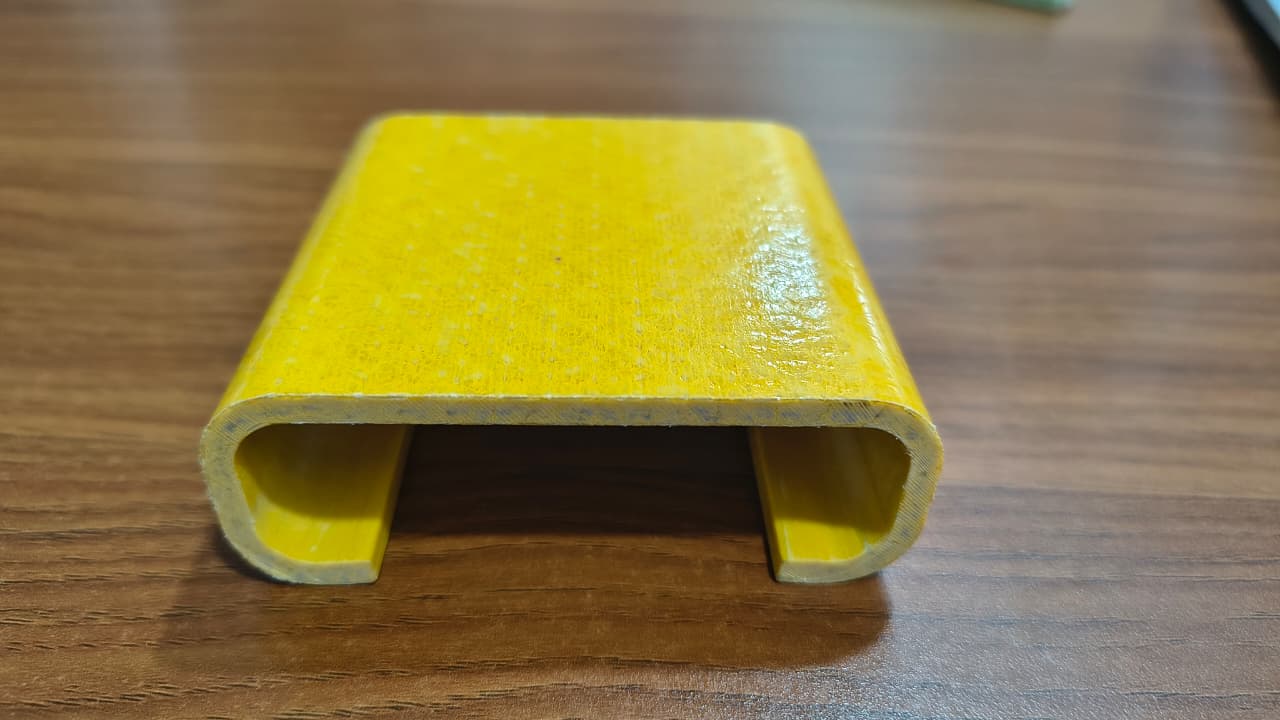
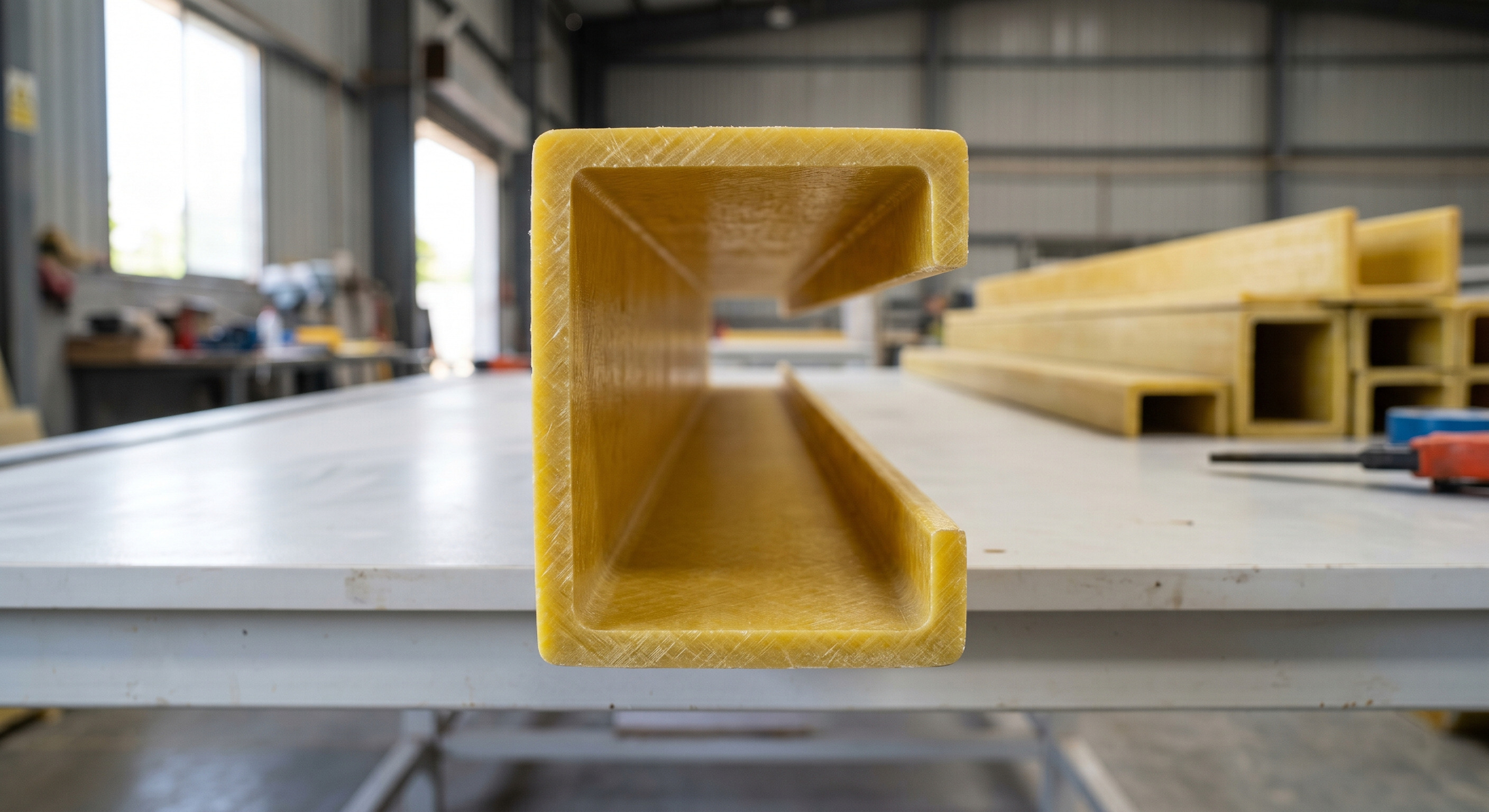
FRP Channel (C-Section) — also referred to as GRP structural channel, pultruded C-channel, or fibre reinforced polymer channel section — is a high-performance structural profile manufactured by the pultrusion process using continuous E-glass fibre rovings and thermosetting resin. The C-shaped cross-section delivers excellent bending resistance and stiffness along its length, with flat flanges on each leg providing a secure bolt-on mounting base.
It is the industry-standard structural section for cable tray side rails, cable ladder rungs, structural framing, conduit support channels, and insulation support structures in environments where steel would corrode, where electrical non-conductivity is required, or where structural dead load must be minimised. ACC Insulations manufactures and distributes FRP C-Section channel to the exact requirements of electrical, civil, and industrial contractors across India.

Technical Specifications
| FRP Channel (C-Section) — Full Technical Data | |
|---|---|
| Product Name | Pultruded FRP / GRP Channel — C-Section Profile |
| Manufacturing Process | Pultrusion (continuous pull-through die forming) |
| Reinforcement | E-Glass continuous fibre rovings & surfacing mat |
| Resin System | Polyester (standard) / Vinyl Ester (chemical resistant) / Fire Retardant Polyester |
| Standard Sizes | 25×25 mm up to 200×75 mm — web height × flange width |
| Wall Thickness | 3 mm / 4 mm / 5 mm / 6 mm (size-dependent; custom available) |
| Standard Lengths | 3 m and 6 m stock lengths; custom cut lengths available |
| Colour | Grey (standard) / Yellow / Custom colour on request |
| Tensile Strength (longitudinal) | ≥ 200 MPa |
| Flexural Strength (longitudinal) | ≥ 220 MPa |
| Compressive Strength | ≥ 150 MPa |
| Density | 1.8 – 1.9 g/cm³ (approx. 25% of steel density) |
| Dielectric Strength | Electrically non-conductive — inherently insulating |
| Thermal Coefficient | Low thermal conductivity — no cold bridging |
| Fire Performance (FR grade) | BS 476 Part 7 Class 1 / UL94 V-0 / IEC 60332-1 (FR resin grade) |
| Operating Temperature | –40°C to +120°C continuous (resin-dependent) |
| Corrosion Resistance | Fully resistant to moisture, chemicals, salt spray, and UV |
| Application | Cable tray side rails, cable ladder rungs, structural framing, insulation support channels, conduit supports |
| Standards | ASTM D638, ASTM D790, ASTM E84, BS 476 Pt 7, IEC 60332-1, customer-specific |
What Is a Channel (C-Section)?
A Channel (C-Section) is a structural profile with a C-shaped cross-section — a vertical web with two horizontal flanges extending in the same direction from either edge of the web. This geometry gives the section its characteristic bending stiffness: the flanges act as the tension and compression flanges of a beam, while the web resists shear forces. The flat undersides of the flanges provide a continuous bolting surface for mounting brackets, clamps, cable tray fittings, and hardware.
When manufactured from pultruded FRP (Fibre Reinforced Polymer), the C-Section profile combines the structural efficiency of the channel geometry with the unique material properties of glass-fibre-reinforced thermoset resin — delivering a section that is simultaneously strong, light, corrosion-proof, electrically non-conductive, and maintenance-free for the service life of the installation.
The C-Section Profile — Engineering Geometry
The C-Section shape is not arbitrary — its geometry is the result of centuries of structural engineering practice, now applied to FRP composite materials. Understanding the three elements of the profile explains why it performs the way it does:
C-Section Profile — Cross-Section Anatomy
H = web height · B = flange width · t = uniform wall thickness · Standard orientation: opening faces inward (toward load)
| Profile Element | Structural Function | Why It Matters |
|---|---|---|
| Top & Bottom Flanges | Carry bending stresses — top flange in compression, bottom in tension under vertical load | Maximises moment of inertia per unit weight; resists beam bending over long spans |
| Web (vertical plate) | Carries shear forces between the two flanges; maintains section height | Increases section depth without adding flange weight — key to bending stiffness |
| Flat Flange Undersides | Provide flat bearing and bolting surfaces for brackets, clamps, and hardware | Eliminates need for special washers or saddle plates; simplifies site installation |
| C-Opening | Allows slide-in mounting of standard bolt heads (M8–M16) without drilling | Enables post-installation repositioning of cable clamps and supports along channel length |
The Pultrusion Process — How FRP Channel Is Made
The consistent mechanical properties and dimensional accuracy of FRP C-Section channel depend entirely on the quality of the pultrusion process. Understanding pultrusion explains why pultruded FRP sections outperform hand-laid or filament-wound alternatives for structural applications:
Fibre Creel Loading
Continuous E-glass fibre rovings are drawn from a creel rack of bobbins. Rovings run the full length of the finished profile — providing the primary tensile and compressive strength in the longitudinal direction. Surfacing mat or woven roving is added to provide transverse strength and improve the surface finish quality.
Resin Impregnation Bath
The fibre bundle passes through an open resin bath or a closed injection chamber where it is thoroughly wet-out with thermosetting resin — polyester for standard grades, vinyl ester for chemical resistance, or fire retardant polyester for FR-rated applications. Full fibre wet-out is critical to achieving maximum mechanical properties and interlaminar bond strength.
Forming & Die Entry
The wet fibre bundle is guided through a series of pre-forming cards that organise and shape the fibres into the C-section geometry before entering the heated steel pultrusion die. The pre-forming stage is critical — fibre alignment and compaction at die entry directly determines the void content and ultimate mechanical properties of the finished section.
Heated Die — Curing
Inside the precisely temperature-controlled steel die (typically 120°C–180°C), the resin undergoes exothermic polymerisation — cross-linking from a liquid to a rigid thermoset solid. The die geometry determines the exact C-section profile dimensions to close tolerances. The cured profile emerges from the die as a continuous solid section.
Pulling & Cut-to-Length
A reciprocating gripper puller mechanism pulls the cured profile continuously out of the die at a controlled speed — hence the name "pultrusion." A flying saw cuts the continuous section to the specified stock length (3 m or 6 m) or customer-specified custom lengths. Cut ends are inspected and edge-sealed before packaging for dispatch.
Standard Size Range
ACC Insulations supplies FRP C-Section channel across a standard size range covering the most common cable tray, cable ladder, and structural framing specifications. All sizes available in standard and fire retardant resin grades:
Light-Duty Channels
25×25, 38×25, 38×38, 50×25, 50×38 mm profiles with 3 mm wall. Used for conduit support channels, small cable tray rungs, and insulation sub-framing where loads are light and spans are short.
Medium-Duty Channels
75×38, 75×50, 100×50 mm profiles with 4–5 mm wall. The most widely specified range for cable ladder rungs, mid-span cable tray side rails, and primary structural framing members in FRP cable management systems.
Heavy-Duty Channels
150×50, 150×75 mm profiles with 5–6 mm wall. Used as cable tray side rails for wide, heavily loaded trays, primary horizontal framing beams in elevated cable tray systems, and main structural members in FRP grating and platform installations.
Extra Heavy-Duty
200×75 mm with 6 mm wall. Specified for long-span cable tray installations, high-load structural framing, and primary beams in industrial FRP structures where deflection limits are critical. Available in vinyl ester resin for chemical plant service.
Non-standard profiles, asymmetric flanges, and special wall thicknesses available on request. Contact our team with your exact cross-section requirement.
Key Performance Properties
Applications of FRP C-Section Channel
FRP Channel vs. Steel Channel vs. Aluminium Channel
Structural designers and project engineers frequently need to evaluate FRP channel against steel and aluminium alternatives. Here is a direct technical comparison on the properties that matter most in cable tray and industrial support applications:
| Property | FRP C-Section | Steel (Galvanised) | Aluminium |
|---|---|---|---|
| Corrosion resistance | ✓ Fully resistant — no coating needed | Limited — zinc coat degrades; rusts in coastal/chemical zones | Good — but pits in alkaline and chloride environments |
| Electrical conductivity | ✓ Non-conductive — inherently insulating | ✗ Conductive — requires bonding/earthing | ✗ Conductive — requires bonding/earthing |
| Weight (relative to steel) | ✓ ~25% of steel — major structural dead load saving | Baseline (100%) | ~35% of steel |
| Maintenance | ✓ Zero — no painting, coating, or inspection for rust | Regular repainting required in corrosive zones | Periodic inspection; anodising can degrade |
| Fire performance | ✓ FR grade meets BS 476 Pt 7 Cl 1, UL94 V-0 | Non-combustible but loses strength at 300°C+ | Non-combustible but softens at 200°C |
| Thermal conductivity | ✓ Low — no cold bridge; no heat path | ✗ High — significant cold bridging in insulated structures | ✗ Very high — worst for cold bridging |
| Stiffness (Young's Modulus) | ~28 GPa longitudinal | ✓ 200 GPa — stiffer per unit area | 70 GPa |
| Material cost | Higher per metre than steel | ✓ Lowest material cost | Moderate |
| Whole-life cost | ✓ Lowest — zero maintenance over service life | High — painting, inspection, replacement in corrosive zones | Moderate |
| Best for | Chemical, offshore, electrical, outdoor, corrosive, and insulated structures | High-load, indoor, non-corrosive, cost-driven projects | Moderate-load, light-corrosion environments |
Why FRP C-Section Is Critical for Cable Tray Systems
Modern electrical cable management systems in industrial, offshore, and infrastructure projects are increasingly specifying FRP C-Section channel as the primary structural element. Three technical drivers explain this trend:
- Corrosion failure of steel cable trays: The most common failure mode in cable tray systems is corrosion of galvanised steel side rails and rungs — particularly in coastal, chemical, water treatment, and mining environments where salt spray, process chemicals, or humidity attack the zinc coating. Once galvanising is breached, the underlying steel corrodes rapidly, compromising structural integrity and requiring complete replacement. FRP channel is inherently corrosion-proof — the glass fibre and resin matrix are unaffected by the same environments that destroy steel, delivering a maintenance-free cable tray structure for the full project life of 25–40 years.
- Electrical safety in live environments: Steel and aluminium cable trays require bonding and earthing because they are electrically conductive. Any breakdown in the earthing system creates a shock hazard and can cause stray current corrosion of adjacent equipment. FRP C-Section channel is inherently non-conductive — no bonding or earthing is required, no stray current paths exist, and maintenance personnel can work safely near the tray system even during live operations, significantly reducing electrical safety risk.
- Structural weight reduction: At approximately 25% of the density of steel, FRP C-Section channel dramatically reduces the dead load contribution of the cable tray system. This is particularly critical in offshore topsides, existing buildings where structural capacity is limited, and elevated cable tray installations where reducing the dead load reduces the size and cost of every supporting structure and foundation below it.
- Cold bridging elimination in insulated structures: In cryogenic pipe supports, cold rooms, and thermally insulated process structures, steel support channels create direct thermal bridges between the cold interior and the warm exterior — causing condensation, ice formation, and insulation degradation. FRP channel has a thermal conductivity of ~0.3 W/m·K versus 50 W/m·K for steel, virtually eliminating cold bridging and preserving the integrity of the thermal insulation system.
Why Choose ACC Insulations for FRP Channel (C-Section)?
Manufacturer & Distributor
Direct manufacturer and distributor of FRP structural sections in Maharashtra. Every length is processed, inspected, and cut in our own facility under direct quality control.
Custom Cut Lengths
We supply FRP C-Section in standard 3 m and 6 m lengths or cut to any custom length required by your project — minimising site waste and reducing installation labour.
Standard & Fire Retardant Grades
Both standard polyester and FR-grade (halogen-free fire retardant) available from stock, meeting BS 476 Pt 7, UL94 V-0, and IEC 60332-1 requirements for cable tray installations inside buildings.
Vinyl Ester for Aggressive Environments
Vinyl ester resin grade available for service in concentrated acids, alkalis, solvents, and elevated temperatures where standard polyester resin would degrade.
Reliable Supply & Delivery
Consistent stock of standard sizes and fast turnaround on custom cut orders ensures your cable tray and structural installation programme is never delayed waiting for materials.
Technical Application Support
Our team advises on section size selection, span-to-load calculations, resin grade selection for your environment, and FRP hardware compatibility for your specific installation requirements.
Engineering Tools Suite
Use our interactive engineering tools to calculate cable tray load capacity, select the correct FRP C-Section size for your span and load, and check deflection limits — all in one place, without manual calculation.
Frequently Asked Questions
An FRP Channel (C-Section) is a structural profile manufactured by pultrusion using continuous glass fibre reinforcement and thermosetting resin. The C-shaped cross-section provides excellent bending resistance and stiffness along its length, with flat base flanges on each leg for bolt-on mounting. It is used as cable tray side rails, cable ladder rungs, structural framing, conduit support channels, and insulation support structures in electrical, industrial, chemical, and offshore environments where corrosion resistance, electrical non-conductivity, and light weight are required.
FRP C-Section channel offers four decisive advantages over steel or aluminium in demanding environments: full corrosion resistance — FRP does not rust or corrode even in coastal, chemical, or wet environments, eliminating ongoing maintenance and replacement costs; electrical non-conductivity — inherently safe near live electrical equipment, no bonding or earthing required; lightweight — approximately 25–30% of the weight of equivalent steel section, reducing structural load and installation labour; and low thermal conductivity — no cold bridging in temperature-controlled or cryogenic facilities. On a whole-life cost basis, FRP channel is typically lower cost than steel in corrosive service environments even when the higher initial material cost is accounted for.
ACC Insulations supplies FRP C-Section channel in standard sizes from 25×25 mm up to 200×75 mm (web height × flange width), with wall thicknesses from 3 mm to 6 mm depending on profile size. Standard stock lengths are 3 m and 6 m. Custom cut lengths, non-standard profile dimensions, and special wall thicknesses are available on request. Contact our sales team with your section size, resin grade, length, and quantity requirement for pricing and lead time.
Yes. ACC Insulations supplies FRP C-Section in both standard polyester resin and fire retardant (FR) grade. The FR grade uses a halogen-free fire retardant resin system meeting BS 476 Part 7 Class 1 surface spread of flame, UL94 V-0, and IEC 60332-1. The FR grade is mandatory for cable tray and cable ladder installations inside buildings, tunnels, and offshore platforms where fire performance is a code requirement. Please specify the FR grade at the time of enquiry.
Yes. Pultruded FRP C-Section channel can be cut to length using a circular saw or angle grinder with a carbide or diamond-tipped blade, and drilled using standard HSS or carbide drill bits — no special tools required. Cut edges should be sealed with a compatible resin or gel coat to prevent moisture ingress into the fibre ends in wet or immersed service conditions. ACC Insulations can also supply channel pre-cut to specified lengths to reduce on-site cutting time and material waste.
An FRP C-Section (structural channel) and an FRP U-Channel differ in their cross-sectional geometry and intended use. A C-Section has flanges extending in the same direction from both edges of the web — when installed with the opening facing inward it provides a stiff bending member with flat mounting flanges; it is the correct profile for cable tray side rails, rungs, and structural framing. A U-Channel has both flanges extending outward from the web forming a trough — it is used for containment, liquid drainage, and cable containment where the trough shape, rather than the structural stiffness, is the primary requirement. C-Sections are the preferred profile for structural cable management applications due to their superior bending and torsional stiffness per unit cross-sectional area.
Yes. We supply FRP C-Section in standard stock sizes and can arrange custom profile dimensions, non-standard wall thicknesses, specific resin systems (vinyl ester, fire retardant, UV-stabilised) and custom colours on request. We also supply pre-drilled holes, punched slots, and surface coatings for specific project requirements. Minimum order quantities apply for non-standard profiles. Please share your full specification — section dimensions, resin grade, length, colour, hole pattern, and quantity — with our sales team for pricing and lead time.
Request a Quote
Get pricing & datasheet within 24 hours