
Table of Contents
- Why Material Selection Is the First Engineering Decision
- Interactive Insulation Selector Tool
- Thermal Classes Explained — Class A to Class C
- Oil-Filled Power & Distribution Transformers
- Dry-Type & Cast-Resin Transformers
- Industrial Motors & Generators
- EV Traction Motors & Inverter-Fed Drives
- MV & HV Switchgear and Control Panels
- Solar Inverters & Wind Turbine Generators
- Full Material Comparison Table
- The 5-Question Decision Framework
- Frequently Asked Questions
Why Material Selection Is the First Engineering Decision
Every electrical insulation specification begins with the same problem: there is no universal insulation material. A material that is ideal for the oil-immersed environment inside a 132 kV power transformer will fail within months in an EV motor subject to 20 kHz inverter switching. A material rated for industrial motor slot liners is completely unsuited for arc-exposed MV switchgear barriers. The wrong selection does not just mean sub-optimal performance — it means premature failure, warranty claims, and safety incidents.
Yet in practice, insulation material selection is often made on habit ("we've always used X") or cost ("Y is cheaper"), without a systematic review of what the application's environment actually demands. The result is insulation systems that are either over-specified (wasting cost) or, more dangerously, under-specified for the real operating conditions.
"Insulation failure accounts for more than 30% of all electrical equipment failures in service. In the majority of cases, the root cause traces back to a material that was wrong for the application's thermal class, dielectric environment, or mechanical load — not to manufacturing defects."
This guide gives procurement engineers, design engineers, and transformer manufacturers a systematic, application-first framework for specifying the correct electrical insulation material. Each section maps a specific equipment category to the insulation materials that have been proven to work in that environment, with the key selection criteria explained for each.
How to use this guide: Start with your application category below (transformer, motor, switchgear, EV, solar, wind). Each section lists the materials required by component function — not just a generic recommendation — along with the thermal class, dielectric performance, and compliance standard relevant to that role.
Interactive Insulation Selector — Find Your Material in 3 Steps
Select your application, operating environment, and thermal class requirement to get a targeted material recommendation with direct links to product pages.
Thermal Classes Explained — IEC 60085 Classification
Every insulation material is assigned a thermal class under IEC 60085 — a maximum continuous operating temperature above which the insulation will age at an unacceptable rate. The class defines the temperature at which the insulation system achieves a useful design life of 20,000 hours (approximately 20 years at continuous rated load). Exceeding the thermal class temperature by 10°C roughly halves the insulation life — the so-called "10-degree rule" of Montsinger.
| Thermal Class | Max Temp (°C) | Typical Materials | Primary Applications |
|---|---|---|---|
| Class A | 105°C | Kraft paper, pressboard, DDP, cotton tapes | Oil-filled transformers (oil limits hot-spot to ~105°C) |
| Class B | 130°C | Phenolic laminates, basic fibre glass composites | Low-duty dry equipment, industrial controls |
| Class F | 155°C | NMN laminates, DMD, G10/FR4, polyester films | Dry-type transformers, industrial motors |
| Class H | 180°C | G11 epoxy laminates, silicone, NHN, mica composites | EV motors, wind generators, high-duty drives |
| Class C | 220°C+ | Pure mica, polyimide film, ceramic composites | Traction motors, aerospace, specialist HV equipment |
Common mistake: Specifying Class A insulation (designed for oil-immersed cellulose systems) in a dry or air-cooled application. Without oil to moderate the hot-spot temperature, ambient air-cooled equipment can easily exceed 105°C at the conductor surface — causing accelerated ageing that will not be visible until the insulation fails in service.
Oil-Filled Power & Distribution Transformers
Oil-filled transformers use mineral transformer oil as both a coolant and the primary long-range insulating medium. Every solid insulation material used inside the tank must be cellulose-based (for oil compatibility) and designed to be fully oil-impregnated after vacuum drying. The oil fills every microscopic pore, eliminating air voids that would initiate partial discharge. This is why no plastic or resin material can substitute for cellulose-based insulation in oil-filled designs.
Oil-Filled Power Transformer (11 kV – 400 kV+)
Thermal Class A — 105°C IEC 60076 | IEC 60641The insulation system of an oil-filled transformer uses different materials for different component functions. Using the wrong grade in even one component — for example, un-compressed pressboard where pre-compressed is required — will cause oil duct narrowing and long-term thermal failure.
Distribution transformer note: Transformers below 33 kV often use calendered (non-pre-compressed) pressboard for cost reasons. This is acceptable at lower voltage classes where winding clamping loads are lighter, but pre-compressed grades are always preferred where precision oil duct maintenance matters — particularly for transformers that will run at high load factors.
Dry-Type & Cast-Resin Transformers
Dry-type transformers — including cast-resin (CRT) and vacuum pressure impregnated (VPI) designs — operate without liquid insulation. The solid insulation materials must perform their full dielectric function in air, and must withstand higher hot-spot temperatures without the moderating effect of oil. This demands Class F or Class H rated materials, not the Class A cellulose materials used in oil-filled designs.
Dry-Type Transformer (VPI / Cast Resin)
Thermal Class F (155°C) or Class H (180°C) IEC 60726Dry-type insulation systems rely on fibre glass composites and flexible laminated films rather than cellulose. The absence of oil means partial discharge voids must be managed by resin impregnation (VPI) or cast resin encapsulation, not oil.
Industrial Motors & Generators
Industrial motors and generators present a demanding mechanical environment alongside the dielectric requirements. Insulation must survive continuous vibration, thermal cycling from load changes, exposure to coolant gases and humidity, and in some applications, physical abrasion. The primary insulation sites are the stator slot (slot liner), the winding end-turns, and the coil-to-coil connection points.
Industrial Motor / Generator (LV & MV)
Thermal Class F (155°C) or H (180°C) IEC 60085 | IEC 60034EV Traction Motors & Inverter-Fed Drives
Electric vehicle traction motors and inverter-driven industrial drives introduce a failure mode that conventional motor insulation was not designed for: inverter-induced partial discharge. Modern SiC and IGBT inverters switch at 5–50 kHz and generate voltage pulses with rise times of less than 100 nanoseconds. These fast pulses create voltage spikes at the motor terminals that can significantly exceed the rated line voltage — often by 2× or more depending on cable length and impedance mismatch. If the insulation system's partial discharge inception voltage (PDIV) is below the peak pulse voltage, PD will occur from day one of operation, eroding insulation at a rate that can cause failure in under 1,000 hours.
EV Traction Motor / Inverter-Fed Motor
Thermal Class H (180°C) or Class C (220°C) IEC 60034-18-41 | IEC 60034-18-42EV motor insulation must satisfy two requirements simultaneously that are often in tension: very high PDIV (to survive inverter pulses) and very thin cross-section (to maintain slot fill factor for power density). Standard NMN laminates do not meet inverter-duty PDIV requirements; ISR (inverter surge resistant) grades or specialist composites must be specified.
Specifying for inverter-fed motors: Always confirm the insulation system's Partial Discharge Inception Voltage (PDIV) against the peak inverter output voltage at the motor terminals (accounting for cable reflections). For drives above 480 V DC bus, ISR or mica-containing insulation is not optional — it is required by IEC 60034-18-41 for Type II inverter-duty motors.
MV & HV Switchgear and Control Panels
Switchgear insulation must satisfy properties that no single material can fully optimise: arc resistance (to survive internal arc events), tracking resistance (to resist creep discharge along surfaces), high compressive and tensile strength (for busbar support), and dimensional stability across a wide ambient temperature range. The dominant material family is fibre glass reinforced plastic (FRP), which outperforms traditional materials like Bakelite and wood across all these properties.
MV / HV Switchgear & LV Control Panels
Tracking resistance CTI >175 | IEC 60893Solar Inverters & Wind Turbine Generators
Renewable energy equipment imposes unique environmental challenges on insulation: solar inverters must survive desert heat cycles and UV exposure; wind turbine generators must withstand sub-zero startup temperatures, high humidity, and the same inverter switching environment as EV motors. Both applications demand Class F or Class H materials rated for wide temperature swings rather than steady-state continuous loading.
Solar String Inverter & Grid-Tie Inverter
Thermal Class F–H | IEC 62109Inverter insulation must meet creepage and clearance requirements for the relevant pollution degree and installation category, plus survive the thermal cycling between cold nights and peak-sun operating temperatures without delamination or cracking.
Wind Turbine Generator (DFIG / PMSG)
Thermal Class H | IEC 60034Wind generators combine the mechanical demands of continuous vibration from rotor mass imbalance with inverter-duty insulation requirements from the variable-frequency converter. Class H or Class C slot liners and ISR-grade insulation are increasingly standard in direct-drive PMSGs.
Full Material Comparison Table — By Key Properties
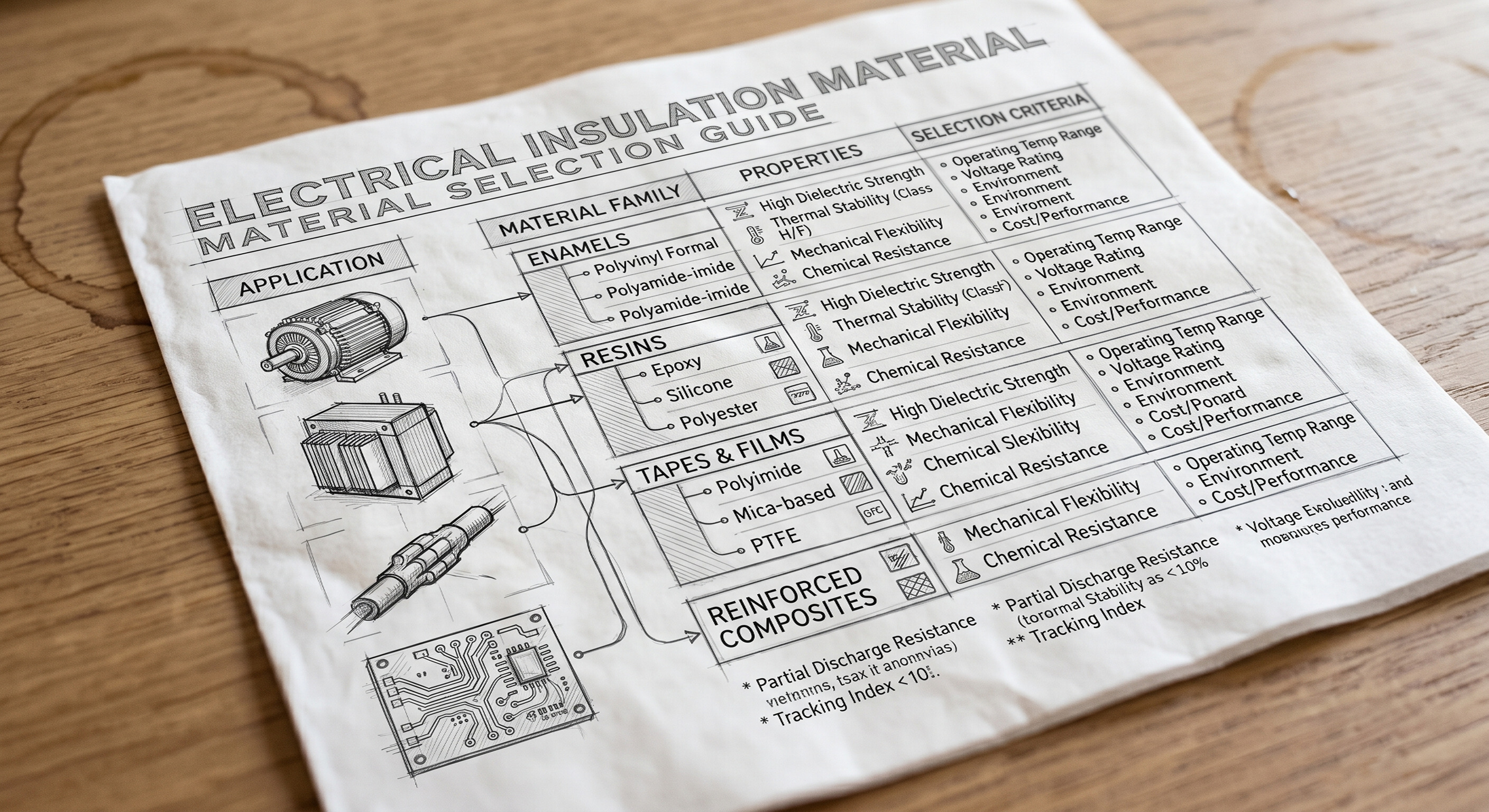
This table summarises the key selection criteria for the most common electrical insulation materials. Use it alongside the application sections above for a complete picture.
| Material | Thermal Class | Dielectric Strength | Oil Compatible | Primary Application |
|---|---|---|---|---|
| Pre-Compressed Pressboard (BP/BPH) | Class A (105°C) | Up to 25 kV/mm (oil) | ✓ Required | Oil transformer cylinders, spacers, barriers |
| Electrical Kraft Paper | Class A (105°C) | 8–12 kV/mm (oil) | ✓ Required | Conductor turn insulation in oil transformers |
| Diamond Dotted Paper (DDP) | Class A (105°C) | 8–10 kV/mm | ✓ Required | Winding layer bonding, self-bonded coils |
| Electrical Crepe Paper | Class A (105°C) | 6–10 kV/mm | ✓ Required | Flexible lead and bushing insulation |
| NMN (Nomex-Mylar-Nomex) | Class H (180°C) | 10–18 kV/mm | ✗ Dry only | Motor slot liners, dry transformer winding |
| DMD (Dacron-Mylar-Dacron) | Class F (155°C) | 8–15 kV/mm | ✗ Dry only | Motor slot liners, VPI transformer winding |
| G10 Fibre Glass Epoxy Laminate | Class F (155°C) | 14–22 kV/mm | ✗ Dry only | Switchgear barriers, motor phase separators |
| G11 Fibre Glass Epoxy Laminate | Class H (180°C) | 14–22 kV/mm | ✗ Dry only | EV motors, wind turbines, high-duty dry equipment |
| FR4 Epoxy Laminate | Class F (155°C) | 12–20 kV/mm | ✗ Dry only | Switchgear barriers, PCB substrates, inverters |
| FRP Pultruded Profiles | Class F–H | 10–18 kV/mm | ✗ Dry only | Busbar supports, arc barriers, structural switchgear |
| FRP Cylinders (Filament Wound) | Class F–H | 12–20 kV/mm | ✗ Dry only | Dry-type coil formers, support insulators |
| Densified Laminated Wood (DLW) | Class A–F | 8–15 kV/mm | ✓ Oil or dry | HV gear, transformer clamping parts, switchgear |
| Glass Fibre Tubes | Class F–H | 12–18 kV/mm | ✗ Dry only | Standoff insulators, end-turn support, bushings |
The 5-Question Decision Framework
If you are unsure where to start, work through these five questions in order. The answers narrow the material family without requiring detailed engineering calculations upfront.
Q1 — Is the equipment oil-filled?
- Yes → cellulose-based materials (pressboard, Kraft paper, DDP, crepe paper)
- No → FRP, epoxy laminates, or flexible composites (NMN, DMD)
Q2 — What is the maximum hot-spot temperature?
- Up to 105°C → Class A (oil systems only)
- Up to 155°C → Class F (NMN, G10, DMD, FR4)
- Up to 180°C → Class H (NHN, G11, ISR laminates)
- Above 180°C → Class C (mica, polyimide)
Q3 — Is the drive inverter-controlled?
- Yes → PDIV must exceed peak inverter voltage at motor terminals
- Yes → Specify ISR or mica-containing insulation (IEC 60034-18-41)
- No → Conventional Class F or H insulation sufficient
Q4 — What is the primary mechanical demand?
- Structural / load-bearing → FRP profiles, DLW, epoxy laminates
- Flexible / winding → NMN, DMD, crepe paper
- Dimensional stability under compression → Pre-compressed pressboard
Q5 — What compliance standard applies?
- IEC 60641 → Pressboard for oil transformers
- IEC 60893 → Fibre glass epoxy laminates
- IEC 60034-18 → Motor insulation (including inverter duty)
- IS 1576 → Indian standard for insulation papers
Use ACC Insulations' interactive tools to calculate wall thickness for your insulation cylinder, check dielectric clearance margins, and select the right pressboard grade for your transformer voltage class — directly from your browser.
Frequently Asked Questions
Oil-filled power transformers use pre-compressed pressboard for structural insulation (cylinders, angle rings, spacers) and electrical-grade Kraft paper for turn-to-turn conductor insulation. Diamond Dotted Paper (DDP) is used where winding layers need to be bonded into a rigid block after oven curing. All three materials are cellulose-based and fully compatible with transformer mineral oil — oil impregnates their pore structure during vacuum drying, eliminating partial discharge voids.
Dry-type transformers (cast resin or VPI) use NMN (Nomex-Mylar-Nomex) composite laminates, DMD (Dacron-Mylar-Dacron), fibre glass epoxy laminates (G10/G11/FR4), and FRP cylinders. These materials do not rely on oil for dielectric performance and are rated to Class F (155°C) or Class H (180°C). Cellulose materials used in oil-filled designs are not suitable for dry-type applications.
Thermal Class F insulation is rated for continuous operation at 155°C, while Class H is rated at 180°C. Class F materials include NMN laminates, G10 epoxy laminates, DMD films, and standard FR4. Class H materials include G11 epoxy laminates, NHN composites, high-grade silicone-impregnated glass fibre, and mica-based products. The correct class is determined by the equipment's maximum operating hot-spot temperature — exceeding the class rating by 10°C roughly halves insulation life.
EV traction motors require insulation resistant to high-frequency inverter switching, with a partial discharge inception voltage (PDIV) above the inverter's peak pulse voltage at the motor terminals. Typical materials include inverter-surge-resistant (ISR) slot liners, NHN (Nomex-Mica-Nomex) composites for turn-to-turn insulation where PD resistance is required, G11 epoxy laminates for structural parts, and glass fibre tubes for end-turn support. Standard NMN laminates used in conventional motors are not sufficient for inverter-duty EV applications above 480 V DC bus.
Medium-voltage switchgear uses FRP pultruded profiles (rods, angles, channels) for bus bar supports and arc barriers, FR4 or G10 laminated sheets for phase separators and barrier boards, fibre glass epoxy components for structural insulation, and glass fibre tubes for standoff support insulators. Densified Laminated Wood (DLW) is used for larger structural insulation components in high-voltage gear. The key selection criteria are tracking resistance (CTI >175), arc resistance, and compressive strength under short-circuit fault current forces.
Generally no — the insulation systems are designed for fundamentally different environments and failure modes. Transformer insulation (pressboard, Kraft paper) is optimised for oil compatibility at Class A (105°C). Motor insulation must survive mechanical vibration, thermal shock from load cycling, and in inverter-fed applications, high-frequency voltage pulses. Motors require Class F or H materials. Some materials like fibre glass epoxy laminates are used in both equipment types, but the grade (G10 vs G11), form (sheet vs tube vs profile), and specification standard differ between the two applications.
G10 is rated to Thermal Class F (155°C) and is suitable for switchgear, LV/MV control panels, dry-type transformer barriers, and motor phase separators where the operating temperature does not exceed 155°C. G11 is rated to Thermal Class H (180°C) and is specified for EV motors, wind turbine generators, high-duty industrial motors, and other equipment where the hot-spot temperature can exceed 155°C. Both materials offer similar dielectric strength and mechanical properties — the key difference is the epoxy resin system's continuous thermal rating. When in doubt, G11 provides a wider safety margin at only a modest cost premium.
Specify the Right Insulation for Your Application
ACC Insulations manufactures and supplies the complete range of electrical insulation materials covered in this guide — from pre-compressed pressboard and transformer kraft paper for oil-filled equipment, to NMN laminates, G10/G11 epoxy sheets, and FRP profiles for dry and switchgear applications. Custom dimensions, OEM volumes, and batch test certificates available.
Request a Quote Use the Insulation Finder ToolFull range · Custom dimensions · IEC compliant · Batch test certificates · Nashik, Maharashtra, India