

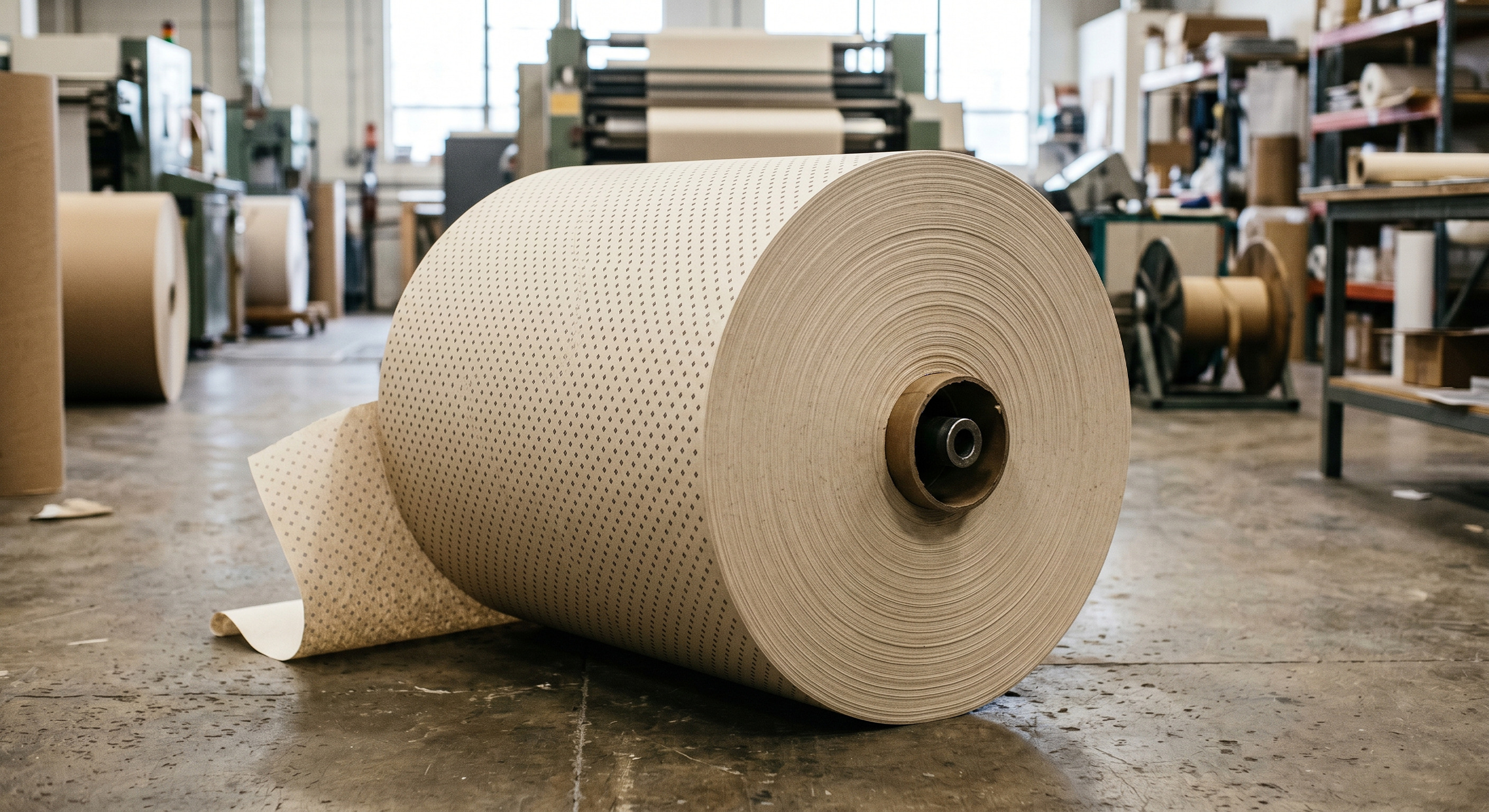

Transformer Winding Insulation — Maharashtra, India
Diamond Dotted Paper (DDP)
Diamond Dotted Paper (DDP) — also known as self-bonding insulation paper, epoxy coated transformer paper, or inter-layer bonding insulation paper — is a specialised electrical insulation material essential to modern transformer winding design. It consists of electrical grade kraft paper coated with B-stage epoxy resin applied in a precise diamond dot pattern.
When the transformer coil is baked, the epoxy cures permanently — bonding all winding layers into a single rigid block that dramatically increases short-circuit withstand strength, mechanical stability, and long-term insulation reliability. ACC Insulations is a premium component manufacturer and distributor of electrical grade DDP to the exacting requirements of transformer OEMs across India.

Technical Specifications
| Diamond Dotted Paper (DDP) — Full Technical Data | |
|---|---|
| Product Name | Diamond Dotted Paper — Electrical Grade (DDP) |
| Base Paper | Electrical Grade Kraft Paper (cellulose kraft, transformer grade) |
| Coating / Resin | B-Stage Epoxy Resin — diamond dot pattern, one or both sides |
| Standard Thickness | 0.12 mm ± 0.007 mm | 0.17 mm ± 0.01 mm |
| Colour | Brown with amber-coloured diamond-shaped epoxy resin dots |
| Curing Temperature | 100°C – 130°C (standard transformer coil baking cycle) |
| Thermal Class | Class F (155°C) / Class H (180°C) — based on resin grade |
| Oil Compatibility | Suitable for mineral transformer oil and ester-based dielectric fluids |
| Dielectric Strength | High — meets IEC 60641 / IS 1576 requirements |
| Roll Width | Standard master rolls; precision-slit to custom widths available |
| Application | Transformer winding inter-layer insulation, self-bonding layer insulation |
| Standards | IEC 60641, IEC 60085, IS 1576, customer-specific requirements |
What Is Diamond Dotted Paper?
Diamond Dotted Paper (DDP) is a high-performance electrical insulation material produced by coating electrical grade kraft paper with B-stage epoxy resin arranged in a regular diamond dot pattern across the surface. The "B-stage" designation is critical — it means the epoxy resin is partially cured (pre-reacted) during manufacturing, leaving it in a solid, non-tacky state at room temperature that can be handled and wound like ordinary paper. It only fully activates and cures when exposed to the elevated temperatures of the transformer's coil baking process.
This unique combination of properties — excellent dielectric insulation in its uncured state, oil-permeable open structure, and permanent rigid bonding after curing — makes DDP the industry-standard inter-layer insulation material for transformer windings worldwide.
The Diamond Dot Pattern — Why It Matters
The diamond dot geometry is not cosmetic — it is a precise engineering solution that simultaneously solves two competing requirements in transformer insulation design:
B-Stage Epoxy Resin — Diamond Dot Pattern
Each ◆ = epoxy bonding dot · Spaces between = oil flow channels
| Design Element | Engineering Function | Why It Matters |
|---|---|---|
| Diamond dots (epoxy) | Bonding points — melt and cure to weld adjacent winding layers together | Creates rigid winding block; resists short-circuit electromagnetic forces |
| Open spaces between dots | Oil flow channels — allow transformer oil to penetrate and fill the winding | Prevents trapped air pockets that cause partial discharge and insulation failure |
| Diamond orientation | Maximises surface area coverage while maintaining continuous oil paths in all directions | Both bonding strength and oil permeability are simultaneously optimised |
How Diamond Dotted Paper Works in a Transformer
Understanding the DDP lifecycle from winding to service helps explain why it is irreplaceable in transformer manufacturing:
Winding — Room Temperature
DDP is wound between conductor layers on the winding machine, just like conventional insulation paper. At room temperature the B-stage resin is solid and non-tacky — it handles identically to plain paper and does not stick to the winding machine components.
Drying — Moisture Removal
The wound transformer coil enters the drying oven at low temperature first, where residual moisture is driven out of the insulation system. This stage is critical — moisture reduces dielectric strength and must be fully removed before oil filling.
Baking — Resin Activation and Curing (100°C – 130°C)
As temperature rises above ~100°C, the B-stage epoxy melts and becomes fluid. The molten resin flows into the microscopic gaps between conductor layers and wets all adjacent surfaces. Held at temperature, the resin completes its cure reaction — chemically cross-linking into a permanently hardened thermoset adhesive that bonds every layer of the winding together.
Vacuum Oil Impregnation
After curing, the transformer assembly is placed under vacuum and flooded with transformer oil. The open channels left between the cured epoxy dots allow oil to penetrate deeply into the winding, displacing any remaining air. Complete oil impregnation is essential for achieving full dielectric strength.
Service — Rigid Bonded Winding
In service, the transformer winding behaves as a single rigid composite unit. Short-circuit electromagnetic forces — which act to collapse LV windings and burst HV windings — are absorbed by the bonded composite structure rather than being concentrated at individual turn-to-turn contact points. This is the primary reason DDP transformers have significantly higher short-circuit withstand strength than unbonded designs.
Standard Thickness Grades
ACC Insulations supplies Diamond Dotted Paper in two standard thickness grades, both available as master rolls or precision-slit to custom widths:
Standard Grade — Thin
The most widely specified DDP thickness. Used as the inter-layer insulation between individual disc winding layers or layer winding conductors in power and distribution transformers. Minimises build-up of insulation thickness per winding layer while maintaining full dielectric and bonding performance.
Standard Grade — Thick
Used where higher dielectric clearance between winding layers is required — typically in higher-voltage transformer designs or where the inter-layer voltage exceeds the clearance achievable with 0.12 mm. Also used as a single-sheet replacement where two layers of 0.12 mm would be otherwise specified.
Custom thicknesses and double-sided epoxy coating configurations are available on request for specific application requirements.
Key Performance Properties
Why Diamond Dotted Paper Is Critical for Transformer Reliability
Modern power and distribution transformers face increasingly severe electrical and mechanical stresses — higher MVA ratings, stricter short-circuit withstand requirements, and longer expected service lives. DDP addresses three of the most common failure modes in transformer windings:
- Short-circuit failure prevention: Without inter-layer bonding, short-circuit electromagnetic forces cause individual winding turns to shift, buckle, or crack the insulation between them. The rigid bonded winding created by DDP distributes these forces across the entire winding structure instead of concentrating them at individual weak points — the primary reason IEC 60076 and most utility transformer specifications mandate bonded windings for high-MVA ratings.
- Partial discharge elimination: Air pockets trapped between non-bonded winding layers are sites of intense partial discharge (corona) activity under high voltage. Over time, PD erodes the insulation paper and accelerates thermal ageing. DDP's oil-permeable dot pattern ensures complete oil impregnation, eliminating residual air pockets and suppressing partial discharge activity throughout the transformer's service life.
- Moisture management during drying: The open channels between epoxy dots also function as moisture migration pathways during the transformer's vacuum drying process, allowing water vapour to escape the winding more efficiently than solid-coated insulation — reducing drying time and improving final moisture content of the finished insulation system.
- Vibration and resonance damping: The bonded winding composite structure also acts as a damping mechanism for the mechanical vibration generated by flux-induced magnetostriction in the core and by load current interactions with the magnetic field. This reduces acoustic noise and mechanical fatigue of the insulation under sustained operation.
Applications of Diamond Dotted Paper
DDP vs. Plain Transformer Kraft Paper
Transformer manufacturers often ask when to specify DDP versus standard electrical grade kraft paper. Here is a direct technical comparison:
| Property | Diamond Dotted Paper (DDP) | Plain Transformer Kraft Paper |
|---|---|---|
| Inter-layer bonding | ✓ Permanent epoxy bond after curing | ✗ No bonding — layers remain loose |
| Short-circuit withstand | ✓ Rigid bonded winding — high resistance | ✗ Individual turns can shift under SC forces |
| Partial discharge risk | ✓ Eliminated — full oil impregnation via dot channels | Moderate — depends on vacuum processing quality |
| Oil impregnation quality | ✓ Guaranteed by open dot channels | Dependent on paper porosity and vacuum depth |
| Mechanical vibration damping | ✓ Composite winding absorbs vibration | ✗ No damping — vibration concentrated at contacts |
| Moisture removal during drying | ✓ Open channels assist moisture migration | Standard — depends on paper structure |
| Cost | Higher per roll | ✓ Lower material cost |
| Best for | Power transformers, HV designs, high SC rating | Low-voltage, small distribution transformers |
The DDP Production Process
The Diamond Dotted Paper we distribute is produced through a controlled multi-stage process designed to ensure consistent resin coverage, uniform dot geometry, and repeatable electrical and bonding performance across every roll:
- Electrical grade kraft paper selection: Only transformer-grade cellulose kraft paper with certified dielectric strength, moisture content, and mechanical properties is used as the base substrate — incoming material is tested before release to production.
- B-stage epoxy resin preparation: The epoxy resin system is mixed and formulated to precise B-stage characteristics — controlling molecular weight, degree of pre-reaction, and cure activation temperature for consistency batch to batch.
- Diamond pattern gravure coating: The resin is applied to the kraft paper surface using a precision gravure roller engraved with the diamond dot pattern. Dot size, pitch, and coverage ratio are controlled to meet the specified bonding strength and oil permeability requirements simultaneously.
- Controlled drying and B-stage arrest: The coated paper passes through a precisely temperature-controlled drying zone that drives off the carrier solvent and advances the resin to exactly the B-stage state — solid, non-tacky, and stable at room temperature but ready to fully activate at 100°C+.
- Slitting and roll finishing: Master rolls are slit on precision slitting equipment to customer-specified tape widths. Rolls are inspected, labelled, and packaged for moisture-protected storage and transportation.
Quality Control & Testing
Every production batch of Diamond Dotted Paper undergoes a comprehensive quality assurance protocol before dispatch:
- Thickness measurement — contact micrometer measurement at multiple points across the web to verify 0.12 ±0.007 mm or 0.17 ±0.01 mm
- Dot coverage inspection — visual and optical check of diamond pattern regularity, dot size uniformity, and absence of coating voids or streaks
- Dielectric strength test — withstand voltage per IEC 60641 to confirm electrical insulation performance
- Bond strength test — sample cured under standard transformer baking conditions; peeled lap-shear test to verify inter-layer bond strength
- Resin content verification — weight-per-area measurement to confirm consistent resin loading across the roll
- Oil compatibility test — cured samples immersed in transformer oil at operating temperature to verify bond stability
Standards compliance: IEC 60641 (paper and paperboard for electrical purposes), IEC 60085 (thermal classification), IS 1576, and customer-specific acceptance criteria.
Why Choose ACC Insulations for Diamond Dotted Paper?
Component Manufacturer & Distributor
We are an electrical insulation component manufacturer and distributor. Every roll of DDP we supply is precision-slit, processed, and tested in our own Maharashtra facility under direct quality control.
In-House Precision Slitting
Our precision slitting equipment cuts DDP to any custom tape width required by your winding machine — eliminating the need for external slitting and ensuring exact width tolerances.
IEC & IS Compliant
All DDP meets IEC 60641, IS 1576, and IEC 60085 thermal class standards. Batch test certificates and material traceability documents provided on request.
Oil & Ester Compatible
Our DDP is qualified for use in both mineral transformer oil and modern ester-based dielectric fluids, supporting eco-friendly transformer designs.
Reliable Supply & Delivery
Consistent production scheduling ensures on-time delivery to transformer manufacturers across India, aligned with your winding production calendar.
Technical Application Support
Our team advises on DDP thickness selection, curing cycle optimisation, and compatibility with your specific transformer design and oil system.
Engineering Tools Suite
Calculate precise dielectric clearances, inter-layer insulation thickness, curing temperature requirements, and DDP selection parameters for your transformer winding design using our interactive engineering tools.
Frequently Asked Questions
Diamond Dotted Paper is an electrical grade kraft paper coated with B-stage epoxy resin in a diamond dot pattern. It is wound between the conductor layers of a transformer winding in its uncured state. During the coil baking process (100°C–130°C), the B-stage epoxy melts, flows between the conductor surfaces, and permanently cures — bonding all winding layers into a single rigid composite block. The gaps between the dots simultaneously create channels for transformer oil to fully impregnate the winding after curing, eliminating air pockets and ensuring maximum dielectric performance.
The diamond pattern solves two competing design requirements at the same time. The epoxy dots provide bonding contact points that permanently lock winding layers together after curing. The open spaces between the dots create continuous oil flow channels — if the paper had solid resin coating, transformer oil could not penetrate the winding, leaving air pockets that cause severe partial discharge and insulation failure. The diamond geometry maximises bonding area while maintaining uninterrupted oil paths in every direction through the winding.
The B-stage epoxy resin in Diamond Dotted Paper activates (melts and begins to flow) above approximately 100°C and fully cures during the standard transformer coil baking cycle, typically at 100°C to 130°C for several hours depending on the transformer size and the manufacturer's oven process. The exact cure cycle — temperature ramp, hold time, and cool-down rate — is determined by each transformer manufacturer's process specification. Once cured, the bond is permanent and thermally stable to the rated thermal class of the material (Class F: 155°C or Class H: 180°C).
During a transformer short circuit, electromagnetic forces try to collapse LV windings radially inward and burst HV windings radially outward — with forces proportional to the square of the short-circuit current. Without bonding, individual winding turns shift and buckle under these forces, causing insulation cracking and inter-turn failure. When Diamond Dotted Paper is used, the cured epoxy bonds every layer into a single rigid composite cylinder that distributes short-circuit forces uniformly across the entire winding cross-section — dramatically increasing the transformer's short-circuit withstand current and preventing winding collapse.
We supply Diamond Dotted Paper in two standard grades: 0.12 mm (±0.007 mm) — the most common specification for layer-to-layer insulation in distribution and power transformers — and 0.17 mm (±0.01 mm) for higher inter-layer voltage applications. Both are available as master rolls or precision-slit to any custom tape width using our in-house slitting equipment. Custom thicknesses and double-sided coating configurations are available on request.
Yes — ACC Insulations' DDP is fully compatible with mineral transformer oil and ester-based dielectric fluids (natural and synthetic esters) used in oil-filled transformers. After curing, the epoxy bond is chemically stable in transformer oil across the full operating temperature range of the rated thermal class. The diamond pattern ensures the oil can completely impregnate the winding after the cure cycle, achieving full dielectric strength.
Yes. We supply DDP in standard master rolls and operate in-house precision slitting equipment to manufacture any custom tape width to your exact transformer winding machine specifications. We supply custom widths, custom roll lengths, and single or double-sided epoxy coating configurations. Our team can also advise on roll weight limits suitable for your winding machine mandrel capacity. Please share your DDP specification with our sales team for pricing and lead time details.
Request a Quote
Get pricing & datasheet within 24 hours