
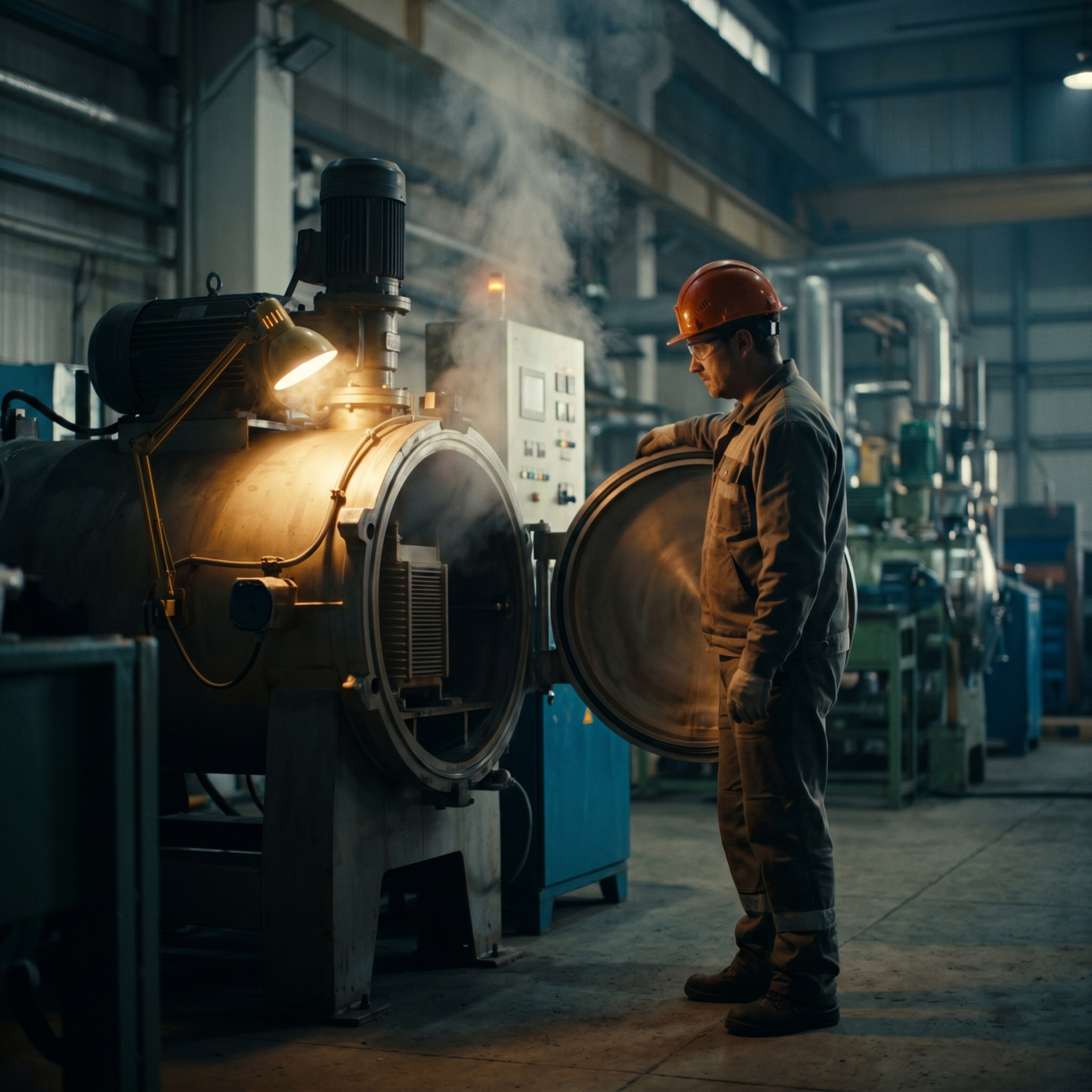
Section 01Why Moisture Destroys Transformer Insulation
Cellulose-based insulation — electrical-grade Kraft paper and pressboard — exhibits a fundamental weakness: hygroscopicity. Both materials absorb moisture aggressively from ambient air during storage, handling, and winding assembly. Even at controlled room humidity, freshly wound transformer insulation can contain 3–6% moisture by weight. Left unaddressed, this moisture content triggers a cascade of failure mechanisms that shorten transformer life from decades to years.
Moisture concentration at 1% in cellulose insulation reduces dielectric breakdown voltage by more than 50% compared to bone-dry paper. At 3% moisture content, the insulation system operates at a fraction of its rated dielectric strength — every partial discharge event silently burns away irreplaceable material. — IEC 60422: Supervision and maintenance of mineral insulating oils in electrical equipment
Three distinct damage mechanisms operate simultaneously in wet transformer insulation:
- Dielectric breakdown strength collapse: Water molecules provide low-resistance conduction pathways through paper and oil. Localized high-field regions discharge across moisture bridges, eroding insulation irreversibly.
- Accelerated thermal ageing: Moisture catalyses hydrolytic degradation of cellulose polymer chains. Each percentage point of excess moisture roughly halves the thermal life expectancy of the paper insulation at any given operating temperature.
- Gas generation under load: Dissolved moisture in oil releases hydrogen and carbon oxide gases under thermal and electrical stress — gases that trigger Buchholz relay trips, distort dissolved gas analysis (DGA) readings, and create bubble-induced dielectric failure at high voltages.
IEC Standard Reference
IEC 60076-1 specifies that oil-immersed transformer insulation must achieve a moisture content below 0.5% (for Class A systems) before oil impregnation. IEC 60422 sets maximum permissible moisture-in-oil values for in-service transformers. Both standards make vacuum drying a non-negotiable production step.
Section 02Insulation Materials Affected by Moisture
Every cellulose component inside an oil-filled transformer demands thorough drying before commissioning. Understanding moisture behaviour in each material guides proper cycle design:
| Insulation Material | Typical Moisture at Ambient | Target After Drying | Drying Difficulty |
|---|---|---|---|
| Electrical-Grade Kraft Paper | 4–7% by weight | <0.5% | Moderate — thin layers dry quickly |
| Pressboard (Solid) | 6–10% by weight | <0.5% | High — dense structure slows diffusion |
| Crepe Paper | 4–8% by weight | <0.5% | Moderate — corrugated surface aids evaporation |
| Diamond Dotted Paper (DDP) | 3–5% by weight | <0.5% | Low–Moderate — open dot channels assist oil and vapour flow |
| Pre-Compressed Pressboard | 5–8% by weight | <0.5% | High — requires extended cycle |
| Transformer Board (T-Board) | 6–9% by weight | <0.5% | Very High — thick cross-section requires extended cycle |
Pressed or solid components — transformer board barriers, end rings, and clamping rings — present the greatest drying challenge because moisture diffuses slowly through dense cellulose structures. These components require the longest exposure to elevated temperature and deep vacuum to achieve acceptable residual moisture levels.
Section 03Drying Methods: Hot-Air Oven vs Vapour Phase
Vacuum Hot-Air Oven Drying
Heat transferred via forced hot air circulation inside a sealed oven chamber under vacuum. External surfaces heat first; moisture migrates outward through the insulation mass. Standard method for distribution transformers and smaller power transformers. Lower capital cost, longer cycle time.
Vapour Phase Drying (VPD)
Kerosene vapour condenses throughout the entire winding assembly simultaneously, heating from within. Uniform temperature distribution eliminates cold spots where moisture stagnates. Preferred for large power transformers and complex winding geometries. Higher capital cost, dramatically shorter cycle time.
Vapour Phase Note
Vapour phase drying requires complete removal of all kerosene condensate before oil filling. Residual kerosene contamination lowers oil flash point and alters dielectric properties. A final deep vacuum hold cycle (≤0.1 mbar) after vapour removal confirms complete condensate evacuation before oil admission.
Section 04Step-by-Step Vacuum Drying Process
Below covers the complete sequence for vacuum hot-air oven drying — the most common method across transformer OEM production lines. Vapour phase steps are noted where the process diverges.
Pre-Inspection & Core-Coil Assembly Preparation
Before entering the oven, the core-and-coil assembly receives a thorough mechanical inspection. Verify all Kraft paper wraps, pressboard barriers, and crepe paper lead covers are intact. Check all insulation components are properly secured — loose paper tends to shift under vacuum, disrupting clearances. Fit lifting lugs, temperature sensors, and dew-point sample lines before oven loading.
Oven Loading & Initial Seal Check
Transfer the assembly into the vacuum drying oven on the trolley rail system. Position with adequate clearance from oven walls on all sides for uniform airflow. Connect thermocouple leads to the data-logging system — minimum three measurement points: top of winding, centre, and bottom. Seal the oven door and perform an initial vacuum hold test (pull to 5 mbar, isolate pumps, monitor for 30 minutes) to confirm door seal integrity before committing the assembly to a full drying cycle.
Atmospheric Pre-Heat Phase
Before applying vacuum, heat the assembly at atmospheric pressure to allow surface moisture to begin evaporating freely. Typical pre-heat temperature: 80–90°C for 4–8 hours. Free evaporation at this stage removes bulk surface moisture efficiently — applying deep vacuum prematurely on a cold, wet assembly forces water to boil suddenly and can mechanically stress fragile paper-wrapped conductors. Gradual warm-up through this phase also prevents thermal shock to pressboard components.
Vacuum Application — Stage 1 (Rough Vacuum)
With assembly at 80–90°C, engage vacuum pumps and reduce chamber pressure in a controlled ramp — not a sudden drop. Target initial vacuum: 10–50 mbar over 1–2 hours. This controlled depressurisation draws out moisture that has migrated to the outer paper layers during pre-heat. Observe the vacuum gauge closely: a rapid pressure rise immediately after pump engagement indicates significant moisture evolution — expected at this stage. Monitor dew point sensor on the exhaust line.
Combined Vacuum & Heat — Main Drying Phase
Raise temperature to 105–120°C while maintaining vacuum at 1–10 mbar. This combination of elevated temperature and reduced partial pressure of water vapour creates maximum moisture evaporation driving force. Water boils at approximately 7°C at 10 mbar — well below the 105°C operating temperature — meaning moisture vaporises rapidly and continuously throughout the insulation mass. Continue this phase until the dew point of exhaust vapour drops to −20°C or below (indicating near-complete moisture removal from the active part).
For large transformers with thick pressboard barriers, introduce periodic vacuum-release cycles — briefly admitting dry nitrogen to atmospheric pressure, then re-evacuating. These nitrogen purge cycles mechanically force moisture toward the surface by pressure differential, accelerating diffusion from deep within solid insulation components.
Final Deep Vacuum Hold
Once the exhaust dew point stabilises below −25°C to −30°C, engage high-vacuum pumps (roots blower backed by rotary vane pump) to pull chamber pressure below 0.5 mbar. Maintain temperature at 105–120°C. Hold final deep vacuum for a minimum of 4–8 hours after dew point target achievement — this final phase extracts residual bound moisture from within cellulose crystal structures that earlier stages could not reach. This stage cannot be shortened without risk of failing final moisture acceptance criteria.
Section 05Measuring Moisture: Dew Point, Tan Delta & Karl Fischer
Confirming adequate drying requires measurement — not assumption. Three complementary techniques apply at different stages of the drying and commissioning process:
Exhaust Dew Point vs Drying Status
Dew Point Measurement
A chilled-mirror or capacitive dew-point sensor on the vacuum pump exhaust line provides continuous, real-time indication of moisture vapour leaving the assembly. Drying progresses as exhaust dew point falls — from initial values of +10°C to +20°C (abundant moisture) toward −25°C to −35°C (near-complete removal). Most transformer manufacturers specify an exhaust dew point ≤−25°C, held stable for 2+ hours, as the primary acceptance criterion before oil filling.
Dielectric Dissipation Factor (Tan Delta)
Tan delta measurement on the winding insulation tracks moisture content indirectly via electrical properties. Wet paper exhibits high tan delta values (0.05–0.15 at 20°C); dry paper falls below 0.01. Trending tan delta across the drying cycle confirms moisture extraction progress in the windings themselves — not merely in the oven exhaust — making it a critical quality verification step before oil admission.
Karl Fischer Titration (Post Oil-Fill)
After transformer oil filling, Karl Fischer titration (KFT) of oil samples per IEC 60814 provides direct measurement of dissolved moisture-in-oil in ppm (mg/kg). Acceptance criteria vary by voltage class — IEC 60422 specifies ≤15 ppm for transformers above 300 kV, ≤25 ppm for 72.5–300 kV class, and ≤35 ppm below 72.5 kV. Elevated values after oil filling indicate either incomplete drying or moisture ingress during assembly — requiring investigation before energisation.
Section 06Oil Filling Under Vacuum
Vacuum oil filling ranks among the most critical steps in transformer manufacturing. Introducing oil to a dried winding assembly without maintaining vacuum defeats the entire purpose of drying — ambient air rushes in with moisture, re-wetting insulation and introducing air bubbles that initiate partial discharge.
Pre-filter & Degas Transformer Oil
Before admission into the transformer, dielectric oil passes through a dedicated oil treatment plant — typically a multi-stage filtration and vacuum degassing unit. Oil must meet IEC 60296 acceptance criteria: dielectric breakdown voltage ≥60 kV (IEC 60156), water content ≤10 ppm (Karl Fischer), and tan delta ≤0.001 at 90°C. Introducing substandard oil to a perfectly dried transformer wastes the entire drying investment.
Maintain Vacuum During Oil Admission
With the transformer still under deep vacuum (≤1 mbar), open the oil admission valve slowly. Oil rises into the tank against the vacuum differential — no air can enter because the tank interior remains at sub-atmospheric pressure throughout. Control oil admission rate to prevent turbulent filling that entrains air at the oil surface. A typical fill rate for distribution transformers: 500–1000 litres per hour.
Post-Fill Vacuum Soak
After reaching fill level, maintain vacuum for an additional 2–4 hours minimum. This final vacuum soak drives remaining dissolved air out of the oil-impregnated insulation. Any residual micro-bubbles trapped in narrow inter-layer channels of the winding stack migrate out under sustained vacuum and are evacuated. Ending vacuum soak prematurely leaves microscopic voids that trigger PD at elevated voltage.
Oil Sample & Dielectric Test
Draw oil samples from bottom and top drain valves. Submit for Karl Fischer moisture (IEC 60814), dielectric breakdown voltage (IEC 60156), tan delta (IEC 60247), and dissolved gas analysis (DGA per IEC 60567). All values must meet acceptance thresholds before proceeding to final assembly, bushing fitting, and test bay despatch.
Section 07Common Vacuum Drying Errors & How to Avoid Them
| Error | Consequence | Prevention |
|---|---|---|
| Applying deep vacuum too rapidly on cold, wet insulation | Violent moisture boiling ruptures cellulose fibres; creates permanent voids in pressboard | Follow controlled pre-heat + gradual vacuum ramp protocol. Never skip atmospheric pre-heat phase. |
| Using exhaust dew point alone as acceptance criterion | Exhaust may show dry readings while core internal pressboard still holds moisture | Combine dew point with tan delta trending and extend final vacuum hold minimum 4 hours after dew point target. |
| Admitting oil with tank open to atmosphere | Ambient air and humidity re-wet insulation; air bubbles initiate partial discharge | Never break vacuum before oil fill; maintain ≤1 mbar throughout oil admission. |
| Filling with untreated or cold oil | Cold, high-viscosity oil fails to penetrate narrow inter-layer channels; wet oil deposits moisture directly onto dried insulation | Pre-treat and pre-heat oil to 50–70°C; verify IEC 60296 acceptance criteria before admission. |
| Shortening the drying cycle to meet production schedules | Residual moisture above 0.5% remains — gradual dielectric deterioration leads to premature failure in service | Drying cycle time is non-negotiable. Brief transformer engineers on the long-term cost of rework vs an extended cycle. |
| Poor oven seal — vacuum leaks | Moisture-bearing air leaks back into the chamber continuously, preventing dew point from reaching target | Perform vacuum hold leak test before every cycle. Replace door seals on a scheduled maintenance interval. |
Section 08Selecting Insulation Materials for Efficient Vacuum Drying
Material choice directly impacts drying cycle time and final moisture levels. Specifying insulation products engineered for low moisture retention and efficient oil impregnation reduces drying cycle duration, lowers energy consumption, and improves quality consistency:
- Diamond Dotted Paper (DDP): Open dot channels between epoxy resin islands act as capillary highways for moisture egress during vacuum drying and for oil ingress during impregnation. DDP-wound assemblies consistently achieve target dew points faster than plain Kraft-wound equivalents due to superior moisture transport through the open channel network.
- Electrical-Grade Kraft Paper: High-purity Kraft paper with low extractable content responds well to vacuum drying. Low lignin and ash content reduces the risk of oil contamination during impregnation. Specifying calendar-grade paper with controlled porosity improves moisture diffusion rates during the drying cycle.
- Pre-Compressed Pressboard: Pre-compressed grades exhibit reduced porosity and higher density than standard pressboard — important for dimensional stability — but require longer drying cycles. Factoring extended drying time into production planning prevents schedule pressure from leading to undertreated insulation.
- Crepe Paper: Corrugated surface texture of crepe paper naturally increases surface-area-to-volume ratio, significantly accelerating moisture evaporation during the oven phase compared to flat paper wraps of equivalent thickness.
Material Sourcing Alert
Insulation paper and pressboard from unverified suppliers frequently fails to meet IEC 60554 and IEC 60641 fibre purity and moisture specifications. Non-compliant base paper absorbs moisture faster, releases more extractable contaminants into dielectric oil, and degrades faster under thermal load. Always source electrical-grade insulation from manufacturers with documented IEC process controls.
Engineering Tools Suite
Calculate dielectric clearance requirements, insulation thickness selection, and thermal class parameters for transformer winding insulation — interactive tools for production engineers.
Section 09Frequently Asked Questions
Source Transformer Insulation Paper & Pressboard from ACC Insulations
ACC Insulations supplies electrical-grade Kraft paper, pressboard, Diamond Dotted Paper, crepe paper, and composite laminates — all manufactured to IEC and IS standards for use in oil-immersed transformer winding and insulation systems.
Kraft paper · Pressboard sheets & boards · Diamond Dotted Paper (DDP) · Crepe paper · Custom slit widths · Technical datasheets on request
Request Insulation Specifications & Samples